

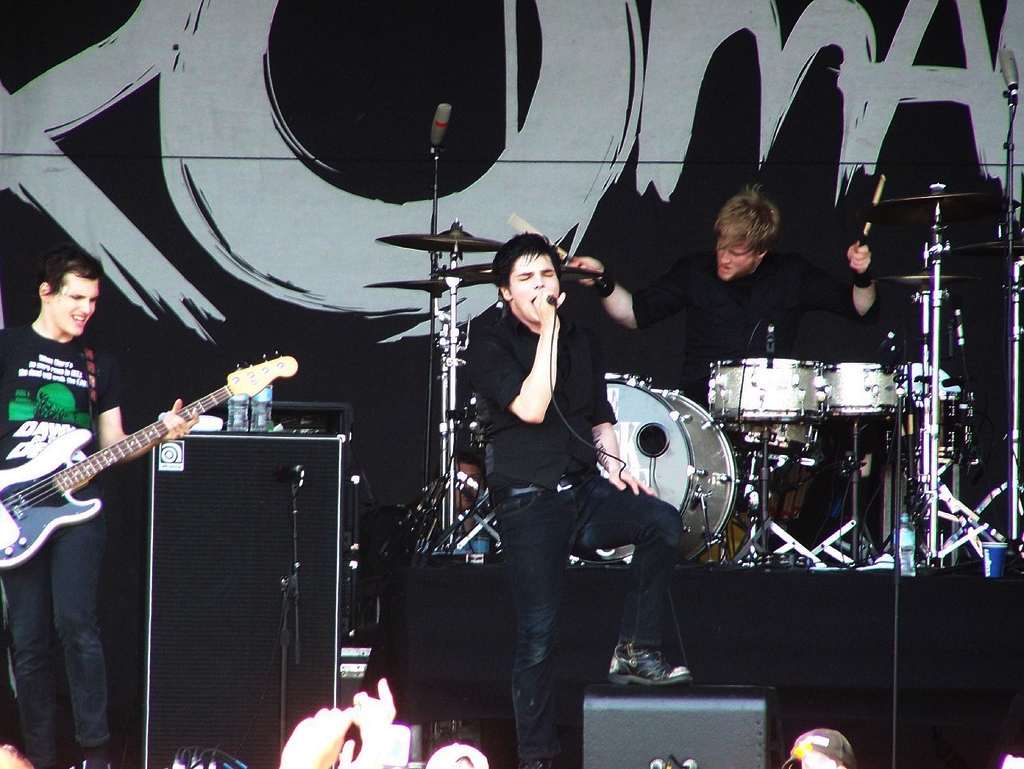
Twenty years after its release, The Black Parade endures because My Chemical Romance made death feel communal rather than solitary. Through the story of a dying man known as the Patient, the band turned fear, regret and memory into theatrical rock built for thousands of voices. Its achievement was larger than making emo ambitious: the album gave private pain the shape of a public procession.
The Anniversary Has Two Dates
The Black Parade carries two widely cited release dates. Spin dated the Reprise release to October 23, 2006, while MusicBrainz catalogs a European configuration on that date. Apple Music and MusicBrainz list the United States release as October 24. Its twentieth anniversary therefore falls across October 23–24, 2026, depending on which release is being observed.
That two-day milestone suits an album fascinated by thresholds. The Black Parade exists between life and death, confession and performance, punk urgency and rock-opera grandeur. It also marks the moment My Chemical Romance stopped sounding merely like a successful band and began presenting itself as an imagined institution.
Following the breakthrough of 2004’s Three Cheers for Sweet Revenge, the group could have refined a proven formula. Instead, contemporary Billboard coverage and Gerard Way’s 2006 interviews describe a deliberate reinvention: My Chemical Romance adopted the identity of the Black Parade, treating the album’s fictional ensemble as an alter ego that extended into its visual presentation and concerts.
Meeting the Patient
The album’s central figure is the Patient, a man confronting an early death. In a 2006 interview, Way described the record as the story of someone dying tragically young. The band’s official twentieth-anniversary description similarly frames it around the Patient reflecting on his life and passing into the afterlife.
Guitarist Ray Toro supplied the essential image in a contemporary quotation published by The Guardian: death comes for each person in a form that feels comforting. For the Patient, that form is a parade he remembers attending with his father as a child. The band’s anniversary description repeats the broader idea that death visits through a cherished early memory.
This premise gives “Welcome to the Black Parade” its emotional force. The song is not simply an invitation into a dramatic world. It imagines death arriving through something familiar, spectacular and strangely reassuring. A childhood memory becomes both an ending and an escort.
The record should not, however, be treated as a libretto with an officially settled plot. Way said interpretation was intentional: the Patient might remain on his deathbed, enter the afterlife or receive another chance at life. In another 2006 interview, he explained that the band discovered recurring characters while writing rather than beginning with a fully mapped concept.
That looseness is part of the album’s longevity. Listeners can follow the Patient without surrendering every song to him.
From a Haunted Mansion to the Studio
The Paramour estate in Los Angeles occupies an outsized place in the album’s mythology. My Chemical Romance used the mansion for writing, rehearsals and pre-production, as the band explained in a 2006 Alternative Press interview. Later accounts from the band and music press likewise describe the group still writing there and experiencing what members regarded as the property’s unsettling atmosphere.
But the Paramour was not the principal location where the finished album was recorded. The original liner notes identify Eldorado Recording Studios in Burbank as the main recording site, with strings and horns captured at Capitol Studios in Hollywood. Engineer Doug McKean later told Mix that many songs were substantially written before the band entered Eldorado.
That distinction matters. The mansion helped shape the songs and the mood; Eldorado and Capitol were where those ideas became the finished production.
Rob Cavallo and My Chemical Romance co-produced the album, with McKean engineering, Chris Lord-Alge mixing and Ted Jensen mastering. David Campbell arranged the strings and horns, according to the liner notes and AllMusic’s credits. The team gave the record scale without sanding away the band’s attack.
Why the Album Sounds So Large
The album’s theatricality comes from accumulation: layered guitars, piano, organ, synthesizers, orchestration, horns and massed vocals. Yet size alone does not explain its impact. The arrangements continually change shape around the Patient’s emotional state.
“The End.” begins with the intimacy of an entrance into a sickroom before the album surges into “Dead!” Elsewhere, “Cancer” strips the spectacle down to the physical and emotional indignities of illness. “Mama” turns dread into grotesque theater, while “Famous Last Words” closes the main narrative with defiance rather than certainty.
Contemporary critics heard Queen’s vocal and guitar grandeur, Pink Floyd’s conceptual reach, David Bowie’s theatrical reinvention and flashes of cabaret or vaudeville. Way himself identified Queen’s A Night at the Opera, Pink Floyd’s The Wall and Bowie’s The Rise and Fall of Ziggy Stardust and the Spiders from Mars as important reference points. Reviews in The Guardian and Spin recognized similar echoes while emphasizing the album’s flamboyant identity.
The influences are visible, but the combination belongs to My Chemical Romance: classic-rock scale delivered with the velocity and emotional directness of a punk-rooted band. The album repeatedly makes one person’s fear sound like an event involving an entire community. Choir-like vocals and marching rhythms turn isolation into participation.
From No. 2 to the Canon
The Black Parade reached No. 2 on both the Billboard 200 and the UK Official Albums Chart, according to the Recording Academy, Billboard’s archived chart and Official Charts. “Welcome to the Black Parade” became My Chemical Romance’s first and only UK No. 1 single, while “Famous Last Words” and “Teenagers” also entered the UK Top 10.
Its early reception was not unanimous, but its ambition was apparent immediately. The Guardian called it one of 2006’s best albums, while Spin awarded it eight out of ten and described its combination of mortality, theatricality, strings and horns. Even favorable reviews recognized that the group had made something deliberately excessive.
Over time, the scale that once risked seeming excessive became central to the album’s standing. Anniversary editions, full-album performances and the band’s return to stadium stages have kept the record in circulation beyond its original scene. What sounded tied to a particular era proved capable of surviving outside it.
The twentieth anniversary completes that transition. Warner Records announced The Black Parade 2026 as a stadium tour across North America, the United Kingdom and Europe. The official anniversary edition is scheduled for October 23, 2026. Its expanded track list adds three B-sides and three performances from the 2007 Black Parade World Tour, including the first official standalone audio release of “Someone Out There Loves You,” long known among fans as “Stay,” according to the band’s store and Official Charts.
The setting has changed from clubs and arenas to stadiums, but the album’s mechanism remains the same. It takes the thought nobody can avoid—that every life ends—and answers with guitars, costumes, memory and a crowd singing together. Twenty years later, the Patient is still approaching the parade, and listeners are still willing to walk beside him.

Leave a Reply