

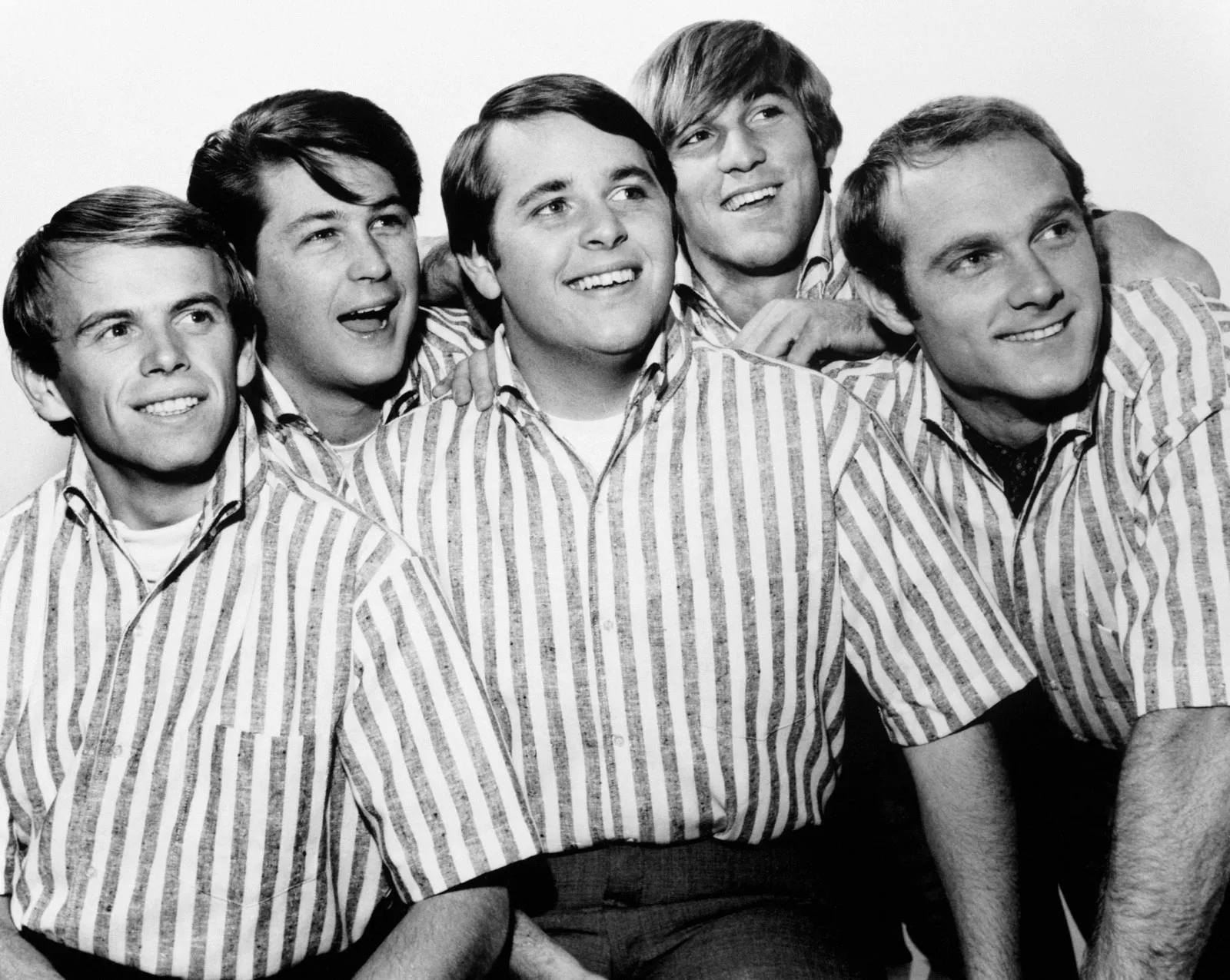
Sixty years after its October 10, 1966, release, “Good Vibrations” remains a landmark because Brian Wilson made radical studio experimentation feel effortless. The Beach Boys’ single was assembled from separately recorded musical sections—more like a film edit than a conventional band performance—yet it still worked as an immediate three-and-a-half-minute pop hit. That balance of invention and accessibility carried it to No. 1 in both the United States and Britain.
A Record Between Two Eras
Work on “Good Vibrations” began on February 17, 1966, while Wilson was still creating Pet Sounds. Session records document an early version with lyrics by Tony Asher, Wilson’s principal lyric collaborator on that album.
The track did not make the final Pet Sounds sequence. Rather than finishing the February performance with a few additional touches, Wilson returned to the song and rebuilt substantial portions of it over the following months. Work on the released version continued through September 21, moving among Gold Star, Western, Sunset Sound and Columbia studios.
That chronology has produced one of the song’s most persistent misconceptions. “Good Vibrations” began during the Pet Sounds period, but it was not originally released on Pet Sounds. Capitol Records issued it as a standalone single, backed with the instrumental “Let’s Go Away for Awhile.” It later appeared on the Beach Boys’ 1967 album Smiley Smile.
The single therefore occupies a revealing position in the group’s history. It carries forward the detailed arranging and studio craft of Pet Sounds while anticipating the modular methods Wilson would pursue during the unfinished 1960s version of Smile.
Building a Song in Pieces
Most pop records of the period were still understood as performances: musicians played a song from beginning to end, and the best take became the foundation of the master. Overdubbing and tape editing were already common, but “Good Vibrations” pushed those practices toward a different creative model.
Wilson treated the composition as a collection of sections. Verses, refrains, transitions and contrasting episodes could be recorded separately, revised independently and tested in different sequences. He also moved between studios to use their particular rooms, equipment and musicians as part of his palette.
The easiest analogy is film editing. A director does not need to shoot a story in the order viewers will see it. Individual scenes can be captured under different conditions, then arranged into a continuous experience. Wilson applied a similar logic to sound, selecting passages and joining them into the released mono master.
The seams were not hidden completely. They became part of the excitement.
“Good Vibrations” begins without a conventional instrumental introduction, placing Carl Wilson’s restrained verse vocal immediately in the foreground. The subdued opening then gives way to a brighter, more rhythmically forceful refrain. From there, the record keeps changing its surroundings: organ colors recede and return, cellos create a striking pulse, percussion reshapes the momentum, and layered voices open new spaces inside the arrangement.
These contrasts are unusually dramatic, but the song never feels like a technical demonstration. Each transition creates anticipation for the next recognizable vocal or instrumental idea. The production keeps moving while the central hook keeps pulling the listener back.
Who Wrote and Sang What
The released record is credited to Brian Wilson and Mike Love. Wilson composed, arranged and produced it, while Love supplied the principal lyrics used on the hit version.
Tony Asher had written words for an earlier version during the Pet Sounds sessions. Most of that lyric was replaced as the song evolved. Love later said he wrote his lyric in about 20 minutes while driving, translating Wilson’s central idea into a direct romantic song about sensing another person’s emotional presence.
Wilson traced that idea to something his mother told him when he was young: dogs could detect favorable or unfavorable “vibrations” in people. In the completed song, that childhood image becomes something less literal—a feeling that can be perceived before it can be explained.
The vocal assignments are also frequently blurred in casual retellings. Carl Wilson sings the principal verses with a calm, intimate tone. Love delivers the low refrain, while the group’s stacked harmonies turn the changing sections into a coherent whole. Brian Wilson masterminded the record, but its lead voice is not simply his own.
The Instrument That Wasn’t a Theremin
The rising electronic line is often identified as a theremin. The actual instrument was an Electro-Theremin, developed by trombonist Paul Tanner and inventor Bob Whitsell and played on the recording by Tanner.
The difference is more than a technical footnote. A conventional theremin is controlled by moving the hands near antennas without touching the instrument. The Electro-Theremin used a mechanical sliding control connected to an electronic oscillator, allowing Tanner to guide its pitch more predictably.
Its wavering tone was ideal for “Good Vibrations.” It sounds both vocal and otherworldly, extending the human harmonies while giving the record an unmistakable electronic signature. Yet it is only one color in a much larger arrangement. The recording’s importance does not rest on a single unusual device, but on the way Wilson coordinated voices, acoustic instruments, electronics, studio acoustics and tape edits.
When Experiment Became a Hit
Capitol released “Good Vibrations” as single 5676 on October 10, 1966. A contemporary Billboard review immediately recognized its unusual rhythmic character and predicted strong commercial results.
The prediction proved accurate. The single reached No. 1 on the U.S. chart dated December 10, becoming the Beach Boys’ third American chart-topper. Britain’s Official Charts Company records that it also spent two weeks at No. 1 there, giving the group its first British chart-topper. Official Beach Boys accounts and contemporary histories identify it as their first million-selling single.
The Recording Academy’s records show three nominations for the Beach Boys connected with “Good Vibrations,” while Brian Wilson received a separate arrangement nomination. The record won none of them. Its reputation endured beyond that contemporary result: the Recording Academy inducted the single into the Grammy Hall of Fame in 1994.
That commercial success is central to the song’s legacy. “Good Vibrations” did not become historically important merely because its production was expensive, complicated or novel. It mattered because listeners embraced the finished result. Wilson compressed months of experimentation, multiple studios and sharply contrasting passages into a record that sounded natural on AM radio.
At 60, the best way to hear “Good Vibrations” anew is to listen past its famous refrain. Notice every doorway: the sudden changes in texture, the voices entering and disappearing, the shifts between intimacy and exhilaration. The record’s wonder lies not only in its individual sounds, but in how confidently it moves from one musical world to another.




Leave a Reply