

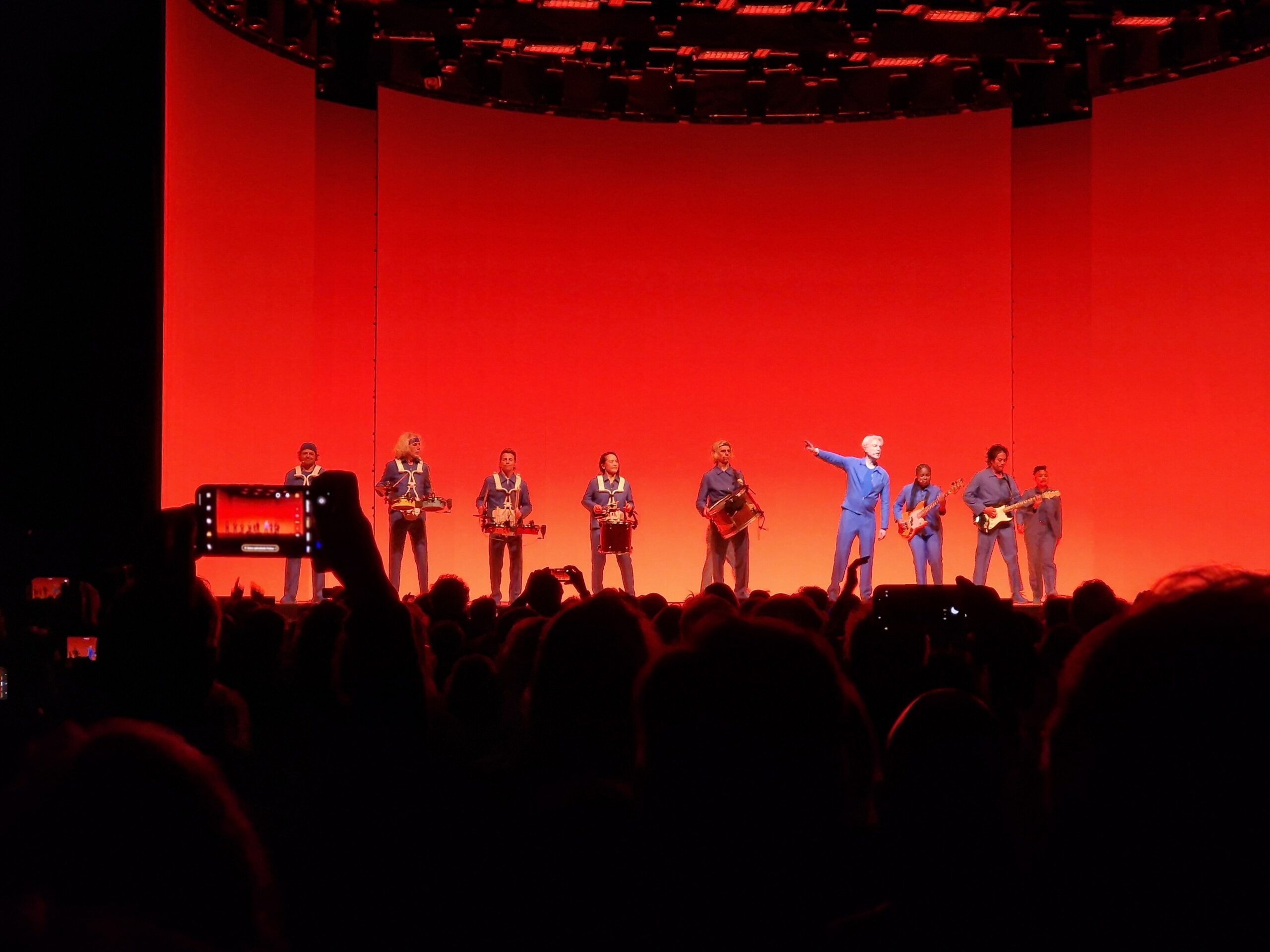
David Byrne turned Elon Musk’s public statements into a song because the words offered a way to portray the man who said them. Created with composer Daniel Pemberton for Alex Gibney’s documentary Musk, “Let Me Sell You a Dream” uses selection, structure and performance to transform Musk’s public language into a musical character study. Byrne said it would be less interesting to criticize Musk overtly than to use his statements and let the song’s character describe himself.
That distinction is what makes the song more than a topical novelty. Byrne does not need to interrupt Musk’s voice with an explicit rebuttal. By deciding which statements belong together—and how audiences should hear them—he can build a point of view without adding an argumentative line of his own.
Why “Let Me Sell You a Dream” Was Created
“Let Me Sell You a Dream” was written for Musk, Gibney’s documentary about the technology executive and public figure. Pemberton, who composed the film’s music, co-wrote the song with Byrne, who performs it.
Gibney described the track as the documentary’s final song in statements published by Variety and Rolling Stone Canada. That placement matters. A closing song does more than accompany the credits or summarize a mood. It can shape the impression viewers carry away from everything they have just seen.
In this case, the film concludes by returning to its subject’s public voice—but that voice has been reorganized and performed by someone else. Musk supplies the language. Byrne and Pemberton supply the frame.
The documentary itself had been in development for years. Jigsaw Productions announced the project in March 2023, while The Guardian reported on March 6 that Gibney was already several months into production. The finished film received a public Venice Film Festival screening on September 8, 2026, after a press-and-industry presentation the previous day, according to the festival’s official schedule and contemporary Associated Press coverage.
How Elon Musk’s Statements Became Lyrics
Byrne said he asked the documentary team for Musk quotations, found additional public statements online and arranged the material into the song.
As reported by Pitchfork, Rolling Stone Canada and Variety, Byrne’s account is that all the lyrics came from Musk. He said he added no editorializing, leaving the arrangement and performance to shape how the statements are heard.
There is an important limit to that claim. The available reporting does not include a phrase-by-phrase record identifying the original interview, speech, post or recording behind every line. The claim that the lyrics consist entirely of Musk’s words is therefore the creators’ documented description of the method, not the conclusion of an independent textual audit.
Even with that qualification, the creative premise is clear: Byrne treated Musk’s public speech as found material. The songwriting took place not only at the level of words, but also through choosing, ordering and presenting them.
How a Quotation-Only Song Can Make an Argument
Using someone’s exact words does not make a finished work neutral.
Imagine a table covered with hundreds of quotations. The artist must decide which ones to pick up, which to leave behind and which to place next to each other. A statement that sounds ordinary in isolation may feel revealing when repeated. Two remarks from different settings may create a new tension when heard in sequence.
Music introduces still more choices. Melody can make language sound triumphant, anxious, comic or mournful. Harmony can support a speaker’s confidence or unsettle it. Tempo affects whether a declaration feels measured or impulsive. Vocal delivery can bring out hesitation, bravado or vulnerability without changing the sentence itself.
Context also carries meaning. The title “Let Me Sell You a Dream” places the selected language inside a story about persuasion, ambition and self-presentation. Its position at the end of Musk encourages viewers to hear the song in light of the documentary that precedes it.
None of this means there is only one correct interpretation. It means the absence of newly written commentary is not the absence of authorship. Byrne and Pemberton’s editorial hand lies in the arrangement.
The technique resembles documentary editing. A filmmaker may use authentic footage and accurately reproduced speech, yet still construct an argument through juxtaposition, duration and sequence. Byrne’s song applies a similar principle to songwriting: the subject’s language becomes evidence, characterization and musical raw material at once.
The Connection to Here Lies Love
The project also fits a longer pattern in Byrne’s work. In 2010, he and Fatboy Slim released Here Lies Love, a 22-track song cycle centered on former Philippine first lady Imelda Marcos and Estrella Cumpas, the woman who raised her as a child. Nonesuch Records documents the album’s April 6 release, format, subjects and collaborators, while contemporary reviews also identify Marcos and Cumpas as the cycle’s central figures.
The earlier project and “Let Me Sell You a Dream” do not use an identical writing method. There is no basis for describing Here Lies Love as a quotation-only work. The connection is broader and more revealing: Byrne repeatedly approaches powerful public figures through voice, persona and musical framing.
Here Lies Love expands that approach across a large song cycle. “Let Me Sell You a Dream” compresses it into one documentary track. Rather than constructing an extended world around its central figure, the new song reportedly works with the public language that figure has already produced.
In both cases, music becomes a way of examining how power presents itself. The listener is not simply given a list of actions or controversies. The public figure is encountered as a performed identity.
The Release and Awards Context
Matador released the standalone track in early October 2026. Film Music Reporter reported it available on October 7, while Beatport lists an October 8 release date. The published records therefore differ by one day, but the song was available by October 8.
Variety and Consequence reported that the song was planned for consideration in the Best Original Song category at the 2027 Academy Awards. That reporting describes an intended entry and eligibility campaign, not an Academy nomination or shortlist placement.
The timing connects the song’s release to the documentary’s U.S. theatrical rollout. Bleecker Street and The Line of Best Fit list an October 9 opening in Los Angeles and New York, followed by a nationwide expansion on October 16.
Those details explain the attention around the track, but its artistic method is more interesting than its awards prospects.
The Subject Becomes the Material
Byrne turned Musk’s quotations into a song because public language is part of a public persona. Musk’s statements do not merely communicate ideas; taken together, they help create the character audiences recognize.
“Let Me Sell You a Dream” uses that accumulated speech as its raw material. Byrne’s contribution is not an added lecture about what the words mean. It is the act of making listeners hear them together, in a chosen order, inside a melody and at the conclusion of a documentary.
That is the larger lesson behind the song. A songwriter does not have to alter someone’s words to alter how an audience hears them.





Leave a Reply