

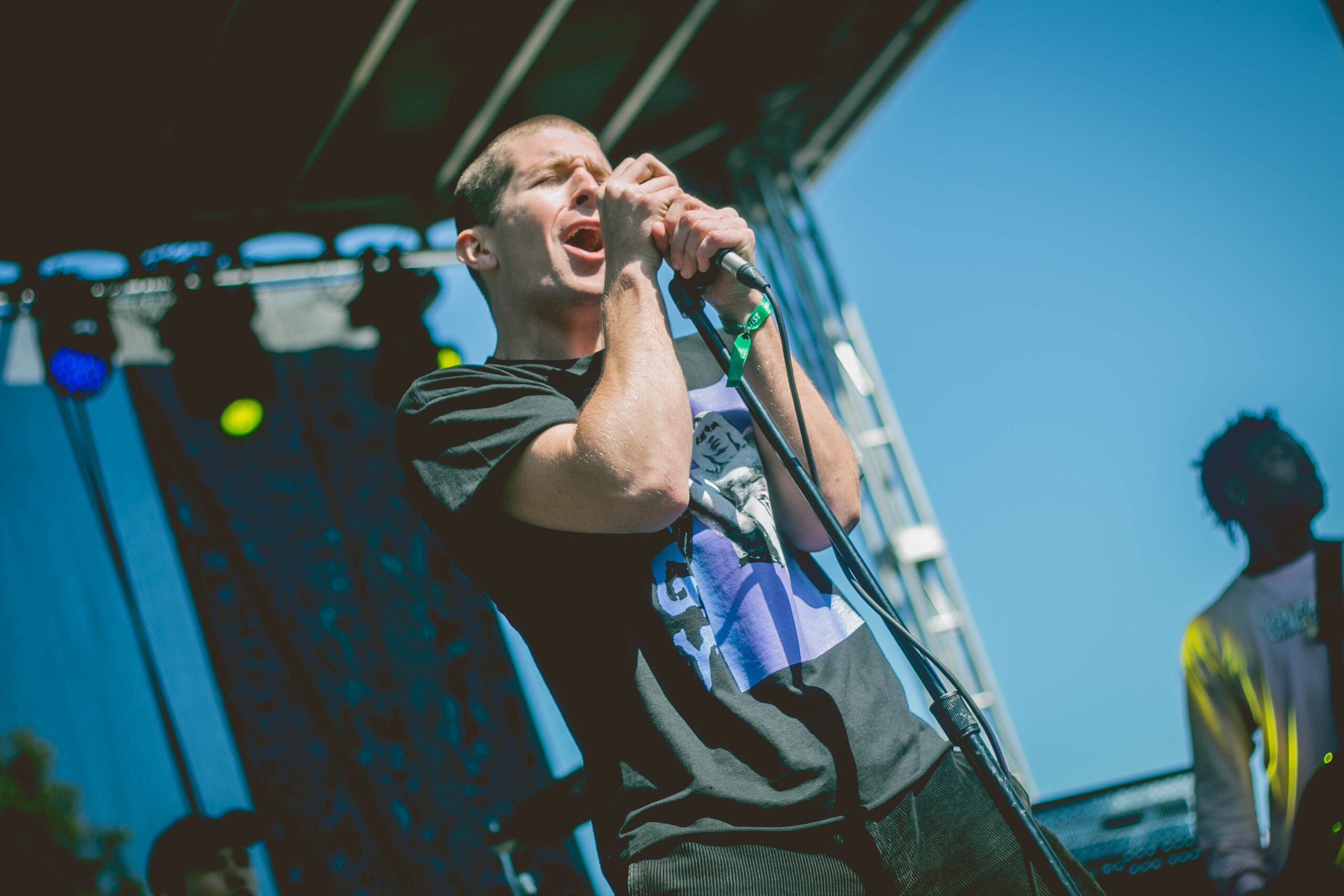
Turnstile became big enough to draw an organizer-estimated 60,000 people by carrying hardcore’s communal energy into music and performances that welcomed a much broader audience. Years of scene credibility, the crossover impact of Glow On, the sustained ambition of Never Enough and two 2026 Grammy wins all helped build that reach. The free Washington Monument benefit did not create Turnstile’s popularity. It revealed how far the Baltimore band’s audience had already expanded—and what that audience could be mobilized to support.
A Stadium-Size Moment in Washington
On October 24, 2026, Turnstile performed on the Washington Monument grounds in Washington, D.C. The National Park Service’s event record confirms the date and permitted location, while Pitchfork documented the completed concert.
Admission was free, with donations collected through a Human Concern International campaign promoted as supporting humanitarian work connected to Palestine, Sudan and Lebanon. By October 26, the continuing fundraiser had passed $260,000, according to the official campaign page, Stereogum and Revolver.
The crowd figure requires care. Human Concern International global director Hassan Wadi announced an estimate of approximately 60,000 from the stage, according to Stereogum’s eyewitness report. Fox 5 DC attributed the same estimate more generally to organizers. No independently audited count has been published.
That distinction matters. Sixty thousand people attending a free public concert is not the same as a band selling 60,000 tickets. Free admission, a central civic location and the benefit’s humanitarian purpose all lowered barriers and widened the event’s appeal. Even with those qualifications, however, assembling a crowd of that scale requires enormous cultural reach.
Turnstile had spent years building it.
Hardcore Supplied the Foundation
Turnstile formed in 2010 within the Baltimore-area hardcore community, according to the Baltimore Banner and AllMusic. That origin explains more than the band’s early sound. It also explains the relationship Turnstile developed with its listeners.
Hardcore is built around participation. The separation between performer and audience is often deliberately thin: people move, shout, stage-dive and contribute to the atmosphere. A show is not simply presented to a crowd. The crowd helps make it happen.
Turnstile learned how to create that kind of involvement before it became a mainstream rock attraction. Its earliest supporters were not responding to a carefully manufactured crossover campaign. They were responding to the physical release, rhythmic force and openness of the band’s performances.
That foundation gave Turnstile something valuable as its music expanded: credibility that did not depend on mass approval. The band could experiment without appearing to be searching desperately for an audience. Its growth felt less like an exit from hardcore than an attempt to see how much room hardcore’s energy could occupy.
Glow On Opened the Door
Glow On became the decisive crossover chapter because it made Turnstile easier to enter without removing the qualities that made the band distinctive.
The record retained speed, heavy guitars and sharp rhythmic impact, but those elements were surrounded by more melody, atmosphere and space. The contrasts mattered. Brighter textures made the heavy passages hit differently, while concise songwriting allowed listeners from punk, alternative rock and other corners of popular music to find a way in.
Turnstile’s achievement was not simply softening hardcore for mainstream consumption. The band made accessibility feel like expansion. Listeners who wanted intensity could still find it. Listeners drawn to melody, movement or visual style no longer needed deep knowledge of hardcore to understand the appeal.
That balance helped prevent the crossover from splitting the band into two incompatible identities. Turnstile did not have to choose between being a hardcore band and becoming a larger cultural presence. It treated those possibilities as connected.
The live show reinforced the point. The same communal movement that worked in smaller rooms could be scaled upward. As more people encountered Turnstile, they were not merely discovering a collection of songs. They were discovering an invitation to participate.
Never Enough Proved the Growth Could Last
A crossover moment can be temporary. The more difficult task is holding the enlarged audience while continuing to change.
Turnstile released Never Enough through Roadrunner Records on June 6, 2025, a date and label credit confirmed by the band’s official store, Apple Music and Spotify. The album represented a test: Was the excitement around Turnstile tied to one breakthrough, or had the band created a durable audience?
The answer became clearer as the group continued working across the boundaries separating hardcore, rock, alternative music and pop-adjacent culture. Never Enough extended Turnstile’s interest in contrast—force against softness, motion against atmosphere, direct impact against more ambitious presentation.
That approach allowed different audiences to hear different points of entry without making the music feel anonymous. Turnstile could occupy larger stages because its songs communicated quickly, but the performances still depended on the collective release associated with its roots.
In other words, the band grew without erasing the behavior that had made it compelling in the first place.
The Grammys Confirmed the New Scale
At the Grammy Awards on February 1, 2026, Turnstile won Best Rock Album for Never Enough and Best Metal Performance for “Birds,” according to the Recording Academy’s official records and Pitchfork’s awards coverage.
The awards did not suddenly manufacture a 60,000-person audience. They did, however, provide institutional confirmation that Turnstile had moved beyond being described merely as a promising crossover act.
A Grammy can introduce a band to casual listeners who do not follow underground scenes, while also increasing media attention around future performances. Winning in both rock and metal categories reflected the breadth of the space Turnstile had come to occupy.
By the time the Washington benefit was announced, the band had several overlapping audiences: longtime hardcore listeners, alternative-rock fans, festival crowds, newer listeners drawn through Glow On and Never Enough, and people who encountered Turnstile through the Grammys.
Why the Benefit Became So Large
The Washington turnout resulted from all those audiences converging around an unusually accessible event.
The concert was free. It took place beside one of the country’s most recognizable landmarks. It was attached to urgent humanitarian causes. The outdoor setting could accommodate people who might not buy a ticket to a conventional Turnstile show, while the band’s reputation promised something more participatory than a passive public performance.
Those factors mean the crowd should not be treated as a clean measure of paid demand. But cultural influence is not measured only at the ticket window.
Turnstile demonstrated the ability to focus attention. Tens of thousands of people reportedly gathered, and the fundraiser exceeded $260,000 within two days of the performance. The event translated musical popularity into public participation and charitable giving.
That is the deeper answer to how Turnstile became this big. The band did not discard the communal logic of hardcore on its way toward mainstream recognition. It enlarged that logic until a gathering rooted in the energy of a local scene could fill the grounds beneath the Washington Monument.
The precise attendance and final charitable total still require fuller accounting. The scale of the achievement does not: Turnstile turned underground trust, musical openness and sustained momentum into a mass audience capable of showing up for something larger than the band itself.




Leave a Reply