

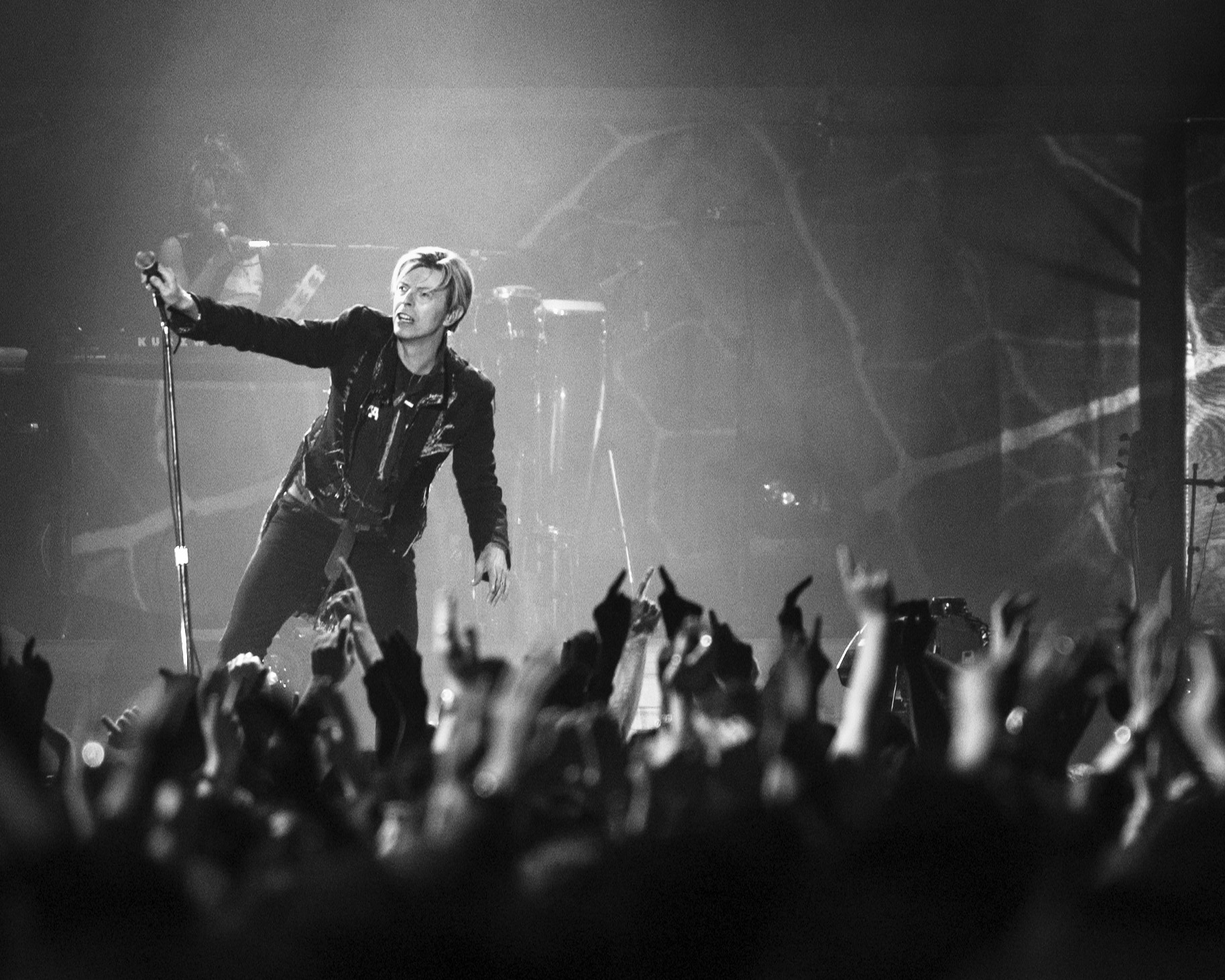
David Bowie “Stage” is a new arena production built around largely unreleased 35mm footage from Bowie’s 1978 Isolar II tour. Directed in its new form by Brett Morgen, it will combine restored images of Bowie at London’s Earls Court with multiple screens, transparent LED displays, synchronized lighting and a specially created 7.1 surround-sound mix. In other words, this is not simply a recovered concert movie. It is a nearly 50-year-old film project reconstructed as a large-scale live experience.
What David Hemmings Filmed in 1978
The footage comes from Bowie’s concerts at Earls Court on June 30 and July 1, 1978. Bowie was then touring behind the remarkable run of music associated with his Berlin period, presenting material from albums including Low and “Heroes” alongside earlier songs.
British filmmaker and actor David Hemmings directed the original shoot. Bowie’s official website identifies him as the director of the project, while the British Council and contemporary reporting describe the surviving material as remastered 35mm footage that was never released as its intended concert film.
The film captures a particularly distinctive Bowie touring group. Adrian Belew played lead guitar, with Carlos Alomar on rhythm guitar, George Murray on bass and Dennis Davis on drums. Roger Powell handled keyboards and synthesizer, Sean Mayes played piano, and Simon House contributed electric violin.
That lineup matters because the footage documents more than Bowie alone. It preserves the musicians responsible for translating his increasingly experimental studio work into an arena performance. Belew’s unconventional guitar playing, the established rhythmic partnership of Alomar, Murray and Davis, and House’s electric violin gave the Isolar II concerts a character specific to this period.
Why Is It Called a “Lost” Film?
“Lost” can be misleading when applied to archival movies. Sometimes it means that no surviving copy is known to exist. In other cases, the footage survives but the intended production was abandoned, withheld or never completed for commercial release.
The second meaning best fits Hemmings’s Stage. The project was known within Bowie’s history, and Bowie’s official website referred to Hemmings’s unreleased film in 2003, more than two decades before the new arena production was announced. What remained unavailable was the intended concert film itself.
The public accounts of why it was shelved do not provide one definitive production history. In comments attributed to Bowie in 2000, he said he had disliked how the concerts were filmed, although he later thought the images looked good. Reporting about Morgen’s archival work also says Bowie was dissatisfied with the editing, while Morgen has suggested that Bowie’s rapid move to other projects made revisiting the tour increasingly unappealing.
It remains unclear whether Hemmings completed a final cut resembling the film he intended audiences to see. Morgen has described finding additional narrative material involving a young actor playing Bowie, but that material has been excluded from the new production.
What has emerged is therefore the underlying performance material, not necessarily a recovered, finished Hemmings movie. That distinction becomes important because the 2027 production gives the footage a new director, structure and presentation technology.
How Brett Morgen Revived the Footage
Brett Morgen encountered the material while working in Bowie’s archive during the development of Moonage Daydream, his 2022 documentary about Bowie. The official 2026 announcement says Morgen unearthed the footage approximately 10 years earlier, while The Guardian dates his initial access to Bowie’s archive to 2017. Discussions about presenting the material in arenas were underway by 2018.
Morgen was a logical choice to shape the new production. Moonage Daydream demonstrated an approach to Bowie’s archive based less on conventional biography than on montage, sound and sensory immersion. The film later won the 2024 Grammy Award for Best Music Film, according to the Recording Academy.
For David Bowie “Stage,” Morgen is working with the David Bowie Estate and live-entertainment company Wonderworld. This collaboration has not attempted to disguise the archival material as a newly filmed Bowie performance. Instead, it places the surviving images inside an entirely new arena framework.
What Audiences Will Experience
The world premiere is scheduled for February 14, 2027, at Berlin’s Uber Arena, in association with the 77th Berlin International Film Festival. The Bowie Estate, the Berlinale and the British Council identify the Berlin presentation as the production’s world premiere.
The experience will spread the restored concert footage across three screens, supported by large-scale projections and transparent LED displays. An integrated lighting design will extend the imagery into the arena, while a new 7.1 surround-sound and spatial-audio presentation will give the recordings a format created for the venue rather than a conventional cinema.
Patrick Woodroffe is responsible for the lighting design, and Oscar-winning sound mixer Paul Massey has prepared the audio presentation. Their involvement helps explain why the production is being described as an arena experience rather than merely a screening.
The result sits somewhere between a concert film, an archival installation and a touring stage show. Bowie remains present through the 1978 performance, but the scale, visual arrangement and surrounding technology belong to a production assembled decades later.
This Is Not the 1978 Album Stage
The new production should not be confused with Bowie’s live album Stage, despite the shared title and tour period.
Released in 1978, the album was assembled from performances recorded in Philadelphia, Providence and Boston. Bowie and Tony Visconti produced it. The film footage at the center of the new arena experience, by contrast, comes from Earls Court in London.
Recordings from the London concerts eventually reached listeners through Welcome to the Blackout (Live London ’78). That album, drawn from the June 30 and July 1 performances, received its first commercial release as a limited triple-LP set for Record Store Day on April 21, 2018.
The distinction is simple but essential: the original Stage album documents American tour dates, while David Bowie “Stage” presents images and sound connected to the London shows. The new experience is not a visual adaptation of the familiar live album.
Why the New Format Matters
The production offers one answer to a growing question: What should an artist’s estate do with important archival material that was never released in its original form?
A traditional restoration might have resulted in a cinema engagement, streaming release or physical edition. Instead, the Bowie Estate and its partners have turned the footage into a location-based event built around a defined combination of screens, sound, lighting and arena-scale presentation. Those technical elements are part of the work rather than accessories to an ordinary film screening.
That model could influence how other major music archives are handled. Unreleased concerts no longer need to appear only as historical documents watched at home. They can be reframed as ticketed productions that borrow the scale and shared atmosphere of live performance.
The approach also raises questions that cannot be answered before the premiere. Hemmings filmed Bowie in 1978, but Morgen is directing the experience audiences will encounter in 2027. How much of the original filmmaker’s structure or intention remains is not yet clear.
That uncertainty is part of what makes David Bowie “Stage” significant. It revives an abandoned chapter of Bowie’s visual history while openly transforming it. The footage belongs to 1978; the arena built around it reflects how artist estates may present the past in the future.










Leave a Reply