

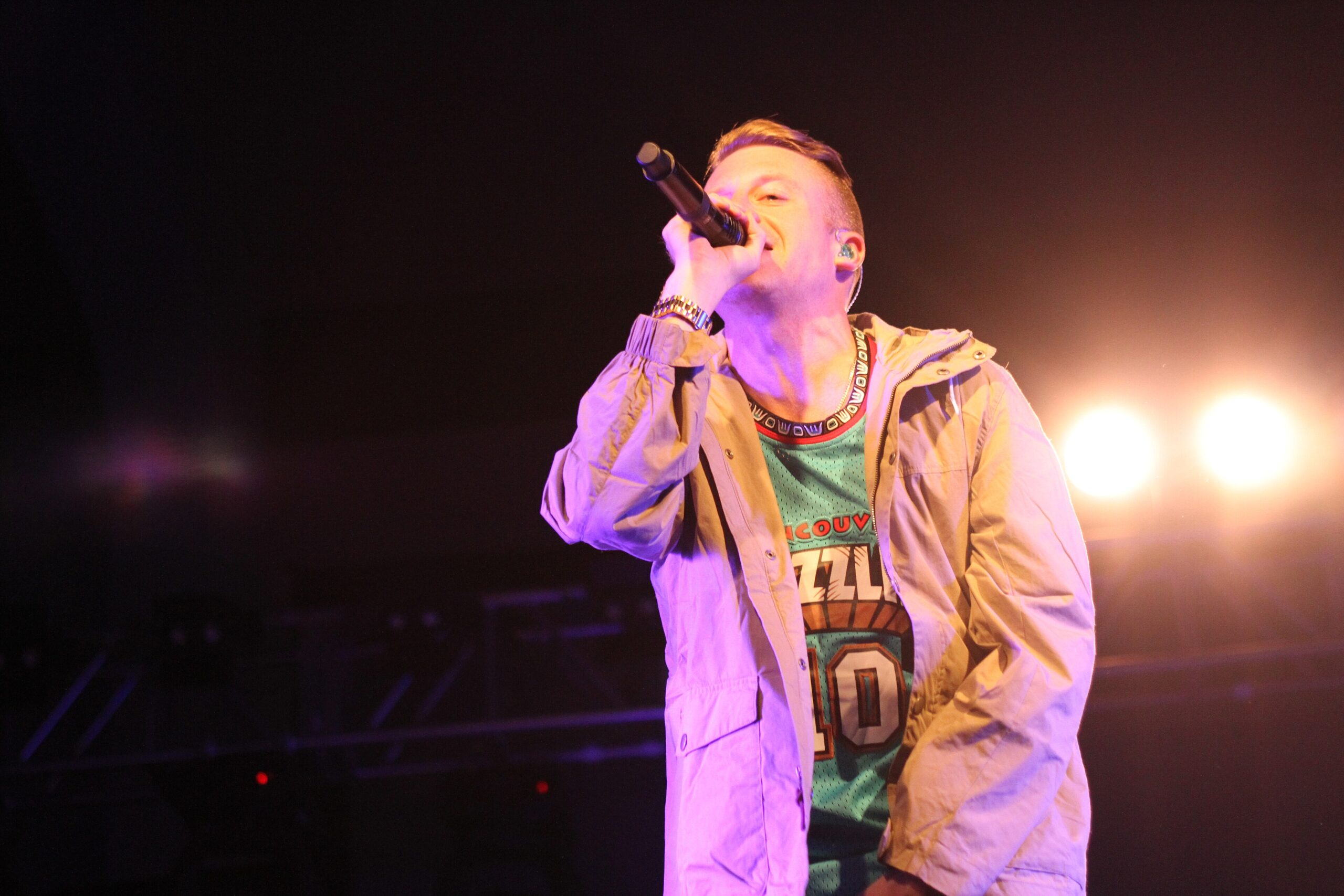
Macklemore was removed from the remaining U.S. dates of Ed Sheeran’s Loop Tour after venues objected to his continued participation following pro-Palestinian speeches at two New Jersey concerts. Messina Touring Group said venues warned that they would not allow concerts to proceed with Macklemore on the lineup. Sheeran said the decision came from the promoter and venues, not from him personally. The reporting confirms that venue pressure preceded the removal, but it does not identify one person as the ultimate decision-maker across every date.
What Happened at MetLife Stadium?
The dispute began on September 4 and 5, 2026, when Macklemore opened two Loop Tour concerts at MetLife Stadium in East Rutherford, New Jersey.
During those appearances, he spoke in support of Palestinians, criticized Israeli policy and performed his protest song “Hind’s Hall” while images from Gaza appeared on the stadium screens. His comments and imagery prompted objections from the Israeli American Council and people who regarded parts of the presentation as offensive or antisemitic.
Macklemore maintained that his criticism was directed at the Israeli government and its policies, not at Jewish people. He said criticism of Israel should not be conflated with antisemitism.
On September 14, Macklemore announced that he had been removed from the remaining U.S. dates of the Loop Tour.
Why Was Macklemore Removed?
The clearest confirmed explanation came from Messina Touring Group, the promoter of the tour’s U.S. leg. The company said venues for upcoming dates had notified it that they would not permit concerts to proceed with Macklemore on the lineup. Keeping him on the bill, the promoter said, would therefore risk cancellations affecting hundreds of thousands of fans.
That distinction matters. Promoters finance and organize tours, negotiate with venues and contract supporting performers. Venue owners retain the ability to refuse access to their properties. Artists capable of filling stadiums also ordinarily possess considerable influence over their tours, although the precise authority involved depends on the contracts and circumstances.
The available evidence therefore supports a narrow conclusion: Macklemore’s MetLife performances triggered objections from multiple venues, and Messina Touring Group subsequently removed him from the remaining U.S. dates.
What the reporting does not establish is a single person who personally ordered his removal from every concert.
Did Ed Sheeran Personally Remove Macklemore?
There is no confirmed evidence that Sheeran personally initiated Macklemore’s removal.
Sheeran said Macklemore’s contract was with the promoter and that removing him was the promoter’s decision. He also said venues had threatened to withdraw their shows if Macklemore remained and that his attempts to reach a resolution through discussions with venues, promoters and activists were unsuccessful.
That account is consistent with Messina Touring Group’s statement that venues had objected to Macklemore’s continued participation. However, music-industry professionals interviewed by the Associated Press said stadium-level headliners generally have substantial approval power, even when the promoter is the primary contractual party.
It is accurate to say Macklemore was removed from Ed Sheeran’s tour because Sheeran was the headliner. It would be misleading to treat that phrasing as proof that Sheeran alone made the decision.
The episode has sometimes been framed as a personal conflict between the artists, but Macklemore described Sheeran as a friend and said he held no ill will toward him. Public reporting has not established a personal feud between them.
What Did Macklemore Say About Robert Kraft?
Macklemore offered a more specific account of how the resistance developed. He alleged that Robert Kraft, whose Kraft Group owns Gillette Stadium, barred him from Sheeran’s two scheduled concerts there and rallied other stadium owners behind an ultimatum against his continued participation.
Kraft confirmed that Macklemore would not be permitted to perform at Gillette Stadium. He said Macklemore’s recent conduct, material displayed during the New Jersey shows and what Kraft characterized as a broader history of antisemitic rhetoric and imagery had been offensive and hurtful to members of the Jewish community.
Kraft’s statement did not confirm that he contacted or organized other stadium owners. Messina Touring Group confirmed that multiple venues objected, but its statement did not say who initiated or coordinated those objections.
That leaves the two claims on different evidentiary footing. Gillette Stadium’s refusal to host Macklemore is confirmed. The claim that Kraft rallied other owners remains Macklemore’s account and has not been independently established.
Other Supporting Performers Withdrew
Macklemore’s removal did not end the disruption to the Loop Tour. Aaron Rowe, Lukas Graham and Finneas withdrew from scheduled supporting appearances in solidarity with him. Beoga, the Irish folk group performing several songs with Sheeran during the middle of his concerts, also left the tour.
Beoga’s role is sometimes described too broadly. The group collaborated and co-wrote material with Sheeran, including “Galway Girl,” and performed a portion of the Loop Tour show with him. It was not simply Sheeran’s full-time backing band for the entire concert.
The withdrawals turned an argument over one artist’s political speech into a larger tour-management problem. They also demonstrated how decisions involving promoters and venues can produce consequences throughout a touring lineup.
How the Dispute Became a Benefit Series
Macklemore redirected the controversy into a new series of concerts. On September 16, he pledged the entire $1 million in net earnings he said he had received from the Loop Tour to six organizations supporting Palestinians. The Associated Press later interviewed representatives of recipient organizations who discussed their shares of the donation.
On September 24, Macklemore announced a three-date “Free Palestine” benefit series in Dublin, Paris and London. Live Nation’s announcement and official venue listings said all proceeds would support 12 humanitarian and advocacy organizations connected to Palestinian relief and rights.
The series opened at Dublin’s sold-out 3Arena on October 26. Hozier, Kneecap and Beoga made unannounced appearances, while Lina Makoul, Palestinian American DJ Habibeats and Dead Prez also performed. The program included activists, an appearance by actor Liam Cunningham and recorded messages from several actors and musicians.
The announced run was scheduled to continue at Paris’s Accor Arena on October 29 and London’s OVO Arena Wembley on October 30.
Which Organizations Were Named as Beneficiaries?
The 12 announced beneficiaries were:
- Anera
- Glia
- Gaza Soup Kitchen
- Taawon
- HEAL Palestine
- Palestinian Youth Movement
- Middle East Children’s Alliance
- Jewish Voice for Peace
- Medical Aid for Palestinians
- Institute for Middle East Understanding
- Palestine Children’s Relief Fund
- UNRWA USA
These organizations were named as intended beneficiaries by the tour announcement and in official listings published by the Paris and London venues. The benefit-series proceeds are separate from Macklemore’s earlier $1 million pledge to six organizations.
What the Controversy Reveals About Major Tours
Macklemore’s removal was not simply a private decision between an opening act and a headliner. It exposed the divided authority behind stadium touring.
Promoters finance and organize tours, contract performers and negotiate with venues. Property owners can refuse to host a performer or event. Stadium-level headliners ordinarily exercise substantial influence, but the extent of their legal control depends on contracts that are rarely public.
In this case, multiple venue objections are confirmed, as is Gillette Stadium’s refusal to allow Macklemore to perform. Sheeran said the promoter made the final decision after attempts at negotiation failed. Macklemore alleged that Kraft helped organize resistance from other owners, but that allegation remains unverified.
What is clear is the consequence. Losing one major platform led Macklemore to build another, turning a tour controversy into a European benefit series centered on the same cause that prompted the dispute.



Leave a Reply