

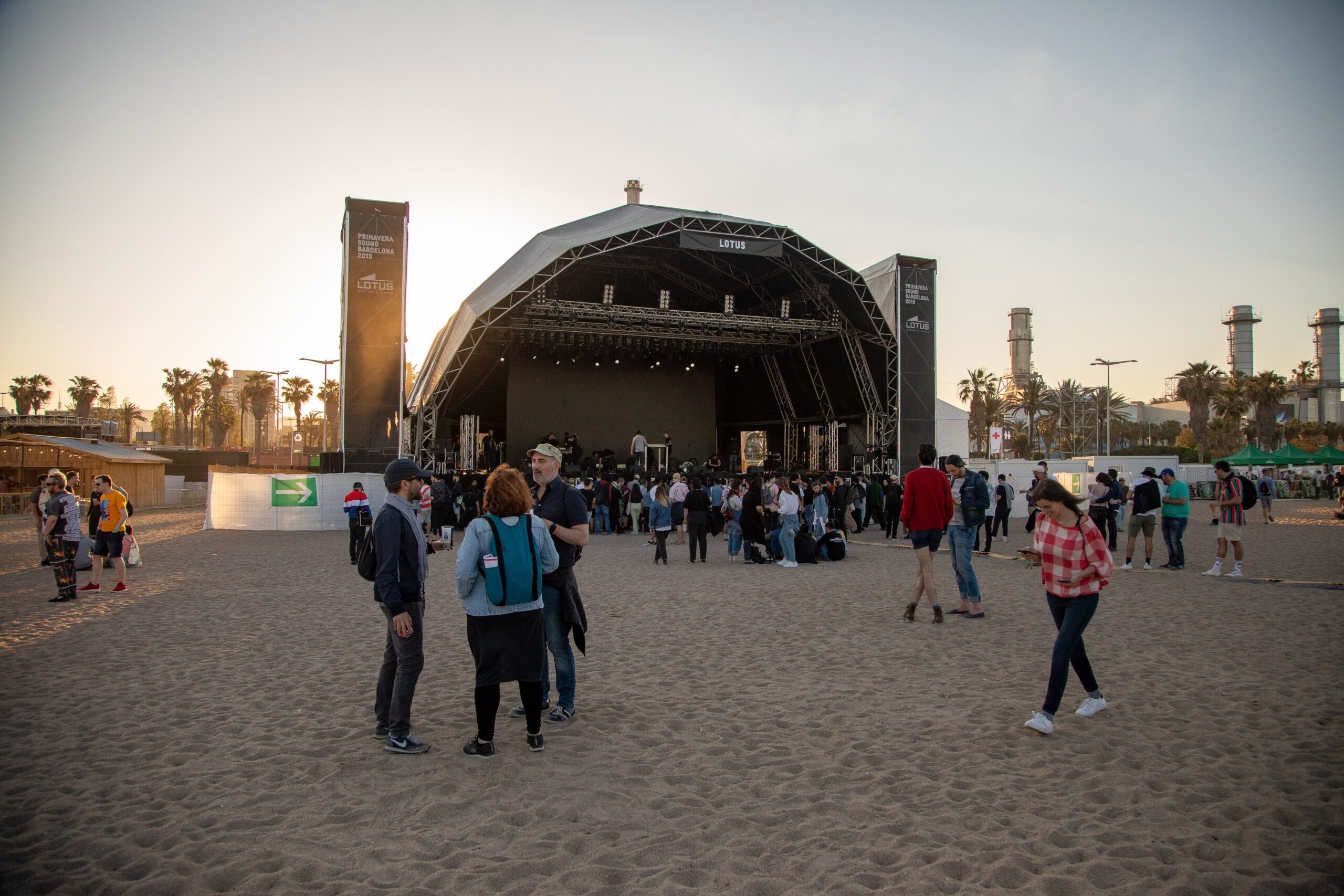
Primavera Sound 2027 appears to have 16 headliners because its poster uses headlining as a shared marketing tier, not simply a list of three nightly closers. Sixteen names receive equal visual weight across pop, rap, rock and electronic music. That does not guarantee identical stages, set lengths or performance times. It tells us how Primavera wants audiences to understand the festival before those practical details are announced.
First, What Counts as a Headliner?
At a conventional three-day festival, the largest name assigned to each day is usually treated as that night’s headliner. Primavera Sound’s poster complicates that familiar system.
Doechii, Phoebe Bridgers, Fontaines D.C., Hayley Williams, FKA twigs, Turnstile, Massive Attack, The Chemical Brothers, Robyn, Bad Gyal, Lola Young, ADÉLA, Caroline Polachek, Prospa, Skrillex and Ninajirachi occupy the same visual tier. Skrillex and Ninajirachi are billed for a back-to-back set.
The result has produced several reasonable interpretations. Spin describes the entire group as headliners. Stereogum emphasizes Doechii, Bridgers and Fontaines D.C. as the first three names while noting that all 16 share the same type size. Pitchfork highlights another selection of artists while presenting a longer headline slate in its report.
Those differences reveal the central issue: “headliner” can describe a poster position, a marketing category or an actual performance role. Until Primavera publishes the daily schedule and stage assignments, the most precise description is a 16-act visual top tier.
Sixteen Names and No Single Center of Gravity
The top tier works less like a ranking than a map of Primavera’s musical identity.
Doechii gives the bill a major rap presence. Bridgers, Williams, FKA twigs, Robyn, Bad Gyal, Lola Young, ADÉLA and Polachek represent overlapping forms of pop, singer-songwriter music and art-pop. Fontaines D.C. and Turnstile speak to different rock audiences, while Massive Attack and The Chemical Brothers bring decades of alternative and electronic history. Prospa and the Skrillex–Ninajirachi pairing push the electronic side of the lineup toward the present.
These categories are necessarily loose. Several of the artists move freely between them. That flexibility is part of the point: Primavera is not asking one genre to define the top of its bill.
Instead, different names can become the festival’s main attraction for different listeners. A Robyn fan, a Turnstile fan and a Doechii fan may each see a different center of gravity, even though they are looking at the same poster.
How Primavera Expanded Beyond Its Indie Origins
Primavera Sound’s current festival format began as a one-day Barcelona event at Poble Espanyol in 2001, according to El País and the festival’s own historical materials. It moved to Parc del Fòrum in 2005, gaining the kind of setting that could support more stages, larger audiences and a broader program.
Its identity expanded with that scale. Primavera did not abandon independent or alternative music; it widened the meaning of what belonged at the festival. Rock, experimental music, pop, rap and club culture increasingly became parts of the same curatorial project.
Representation also became an explicit part of that identity. In 2019, Primavera introduced “The New Normal,” a campaign built around a gender-balanced lineup. The Primavera Sound Foundation describes it as the first major international festival to reach that balance, while the Recording Academy reported that women made up more than half of the edition’s 226 acts.
The 2027 poster turns that wider institutional identity into a visual argument. Cultural importance, it suggests, does not belong to one genre, generation or measure of mainstream fame.
Why a Flatter Poster Works
A broad top tier gives Primavera several commercial and editorial advantages, even if organizers have not publicly identified those advantages as the reason for the design.
First, it allows the festival to address multiple audiences at once. Rather than asking every potential buyer to accept the same three stars as the event’s unquestioned center, Primavera can present several entry points.
Second, it spreads attention across more bookings. A campaign organized around three enormous names depends heavily on those artists to establish value. A 16-act tier distributes that appeal across different genres and fan communities.
Third, the structure strengthens Primavera’s reputation as a curator. The message is not merely that famous artists are appearing. It is that the festival considers this particular combination of artists significant.
The depth of the lineup supports that claim. Stereogum and Pitchfork both report bookings including Pavement, King Gizzard & the Lizard Wizard, Tinashe, Underworld, ANOHNI, Arca, Bleachers, Weyes Blood, Julien Baker, Dinosaur Jr., Converge, Juana Molina and Mabe Fratti. Recognizable artists extending far below the largest type make the bill less dependent on a traditional superstar pyramid.
An Anniversary Bigger Than Three Closing Sets
The 2027 event is Primavera Sound’s 25th Barcelona edition. Organizers have announced 151 artists and bands across a program running June 2–6. The main Parc del Fòrum festival is scheduled for June 3–5, with a free opening day on June 2 and an electronic closing program on June 6.
RTVE, Spin and Pitchfork report that Richie Hawtin, Four Tet and Dixon will alternate during that finale. Primavera Pro, the festival’s professional conference and showcase operation, will hold its 18th edition at DHub alongside the festival.
Together, those elements encourage audiences to view Primavera as an institution rather than three headline concerts surrounded by supporting acts. The anniversary encompasses live performances, club culture, industry activity and the accumulated history of the festival itself.
Massive Attack’s return to the bill adds another kind of history. El País and DJ Mag reported that rain and wind forced the cancellation of the group’s Primavera performance on June 4, 2026. Pitchfork and Stereogum identify the band’s 2027 booking as a return. It carries a sense of unfinished business without needing to be presented as an official makeup show.
Equal Type Size Does Not Mean Equal Stage Time
The poster still leaves the festival’s operational hierarchy unresolved.
It does not show which days the top-tier artists will perform, which stages they will occupy, who will close the principal stages or how long their sets will last. It also does not establish that all 16 will receive equivalent production.
That distinction matters. Poster equality is symbolic and promotional. Scheduling requires choices about capacity, sound, production and audience movement. The eventual timetable may reveal a much more conventional hierarchy beneath the artwork.
For now, the equal billing helps sell full-festival access before buyers can compare individual days. Primavera’s official fan-sale page, El País and The Fader list a registered fan-sale price of €295 plus fees and a VIP price of €545 plus fees. El País and The Fader report that the general full-festival price will be €350 plus fees, with VIP admission remaining €545 plus fees.
A long top tier gives prospective attendees more reasons to commit to the complete event without knowing exactly where each artist will land.
The Festival Is Selling Its Taste
So why does Primavera Sound 2027 have 16 headliners? Because the poster defines headlining as shared cultural prominence rather than a promise that 16 artists will perform the same job.
The design reflects Primavera’s journey from a one-day event into a genre-spanning festival capable of placing Doechii, Robyn, Fontaines D.C., Massive Attack and Skrillex with Ninajirachi on one symbolic level. It also makes the festival’s taste—its ability to connect different scenes, eras and audiences—the most stable attraction on the bill.
In that sense, Primavera itself is the ultimate headliner. The schedule will show how much of the poster’s visual equality survives once the music is assigned to actual days, stages and closing slots.


Leave a Reply