

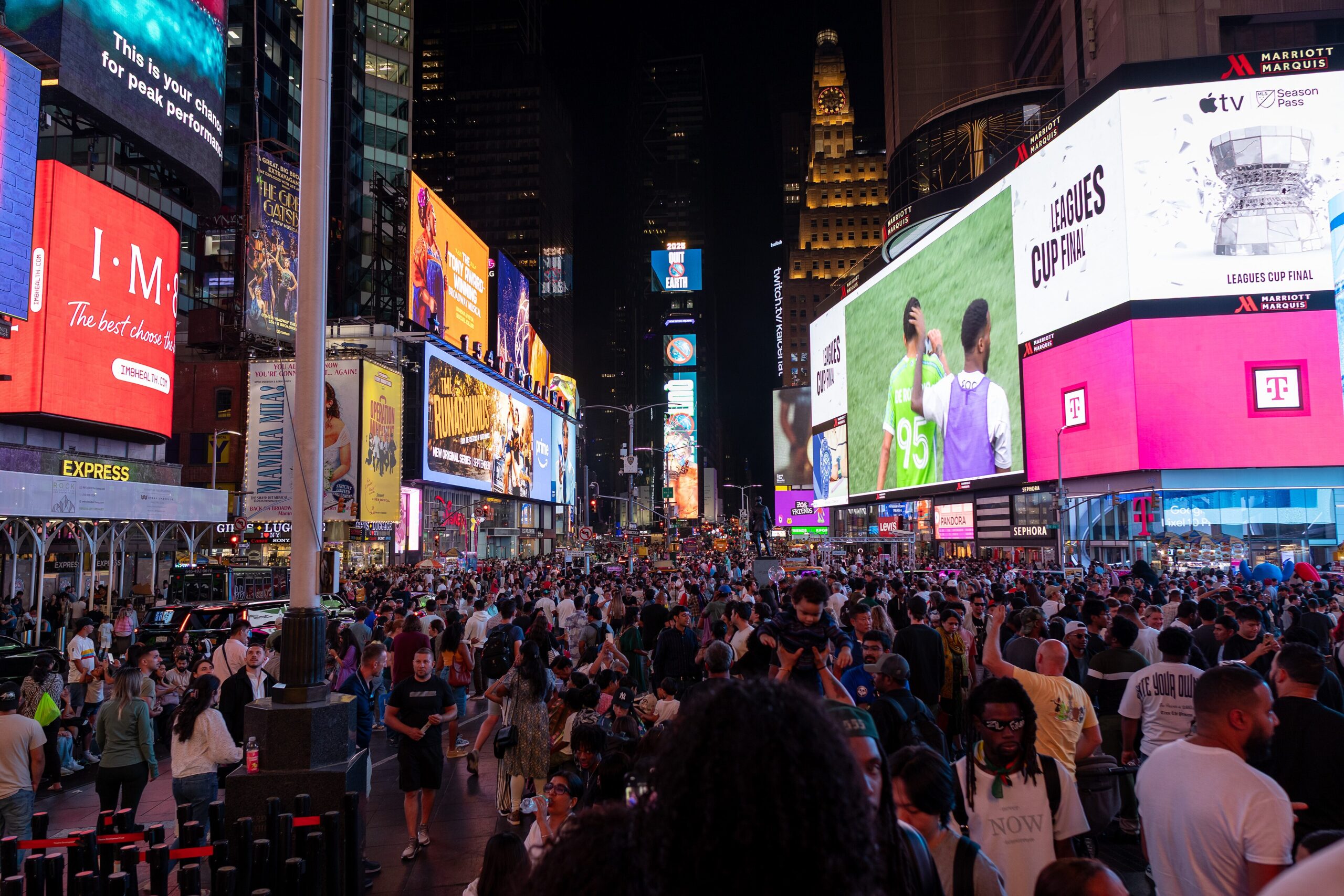
Haywire was in Times Square to perform and film a pop-up video shoot for “Flex Your Head.” The Boston hardcore band announced the exact location shortly before the October 28, 2026, appearance, finished the song and began a second before New York Police Department officers stopped the performance. What lasted only a song and a half also captured Haywire’s larger strategy: turning the energy of a hardcore show into a highly visible moment during the release cycle for its first Roadrunner Records album.
What Happened During Haywire’s Times Square Set?
Haywire’s performance began with “Flex Your Head,” the song at the center of the planned video shoot. After completing it, the band launched into “Haywire.”
That was as far as the set got.
Coverage from Stereogum, Consequence and Alternative Press documented officers intervening during the second song. Reports and footage showed officers taking the drummer’s sticks and disconnecting or removing equipment while the gathering dispersed.
The entire performance lasted approximately one and a half songs. That makes it a striking piece of footage, but not much of a conventional concert. There was no full set, no extended program and little time for the event to develop before it ended.
It is also important to describe the officers’ actions carefully. The available reporting shows equipment being disconnected or carried away from the performance area, but it does not establish whether anything was formally confiscated, entered into evidence or retained afterward.
Why Was Haywire Performing There?
The Times Square appearance was promoted as a pop-up video shoot for “Flex Your Head,” according to reports from Lambgoat, ThePRP and Stereogum. It functioned as both a public performance and an attempt to capture a music video—or at least material that could be used for one—in one of New York City’s most recognizable locations.
The location was revealed at the last minute. Consequence and ThePRP reported that Haywire shared a Times Square image, coordinates and instructions telling followers not to gather at the designated spot until 8:55 p.m. Stereogum and Alternative Press also described the location notice as arriving roughly an hour before the performance.
That compressed announcement window was part of the event’s character. Rather than promoting a normal show with a venue, doors time and advance ticketing, Haywire directed people toward a public space shortly before the band was ready to play.
The result was deliberately immediate, even if the police response itself should not be treated as planned. There is no reliable evidence that Haywire or Roadrunner Records engineered the shutdown as a publicity tactic.
A Video Shoot That Lasted One Song and a Half
The confirmed sequence is short and unusually clear.
First, Haywire performed “Flex Your Head.” Then the band began “Haywire.” Officers intervened during that second song, removed the drummer’s sticks and disconnected or moved equipment. The gathering then broke up.
Because “Flex Your Head” was completed, the band may have captured usable material before the interruption. However, no confirmed information establishes whether the Times Square footage will become an official video.
The distinction between a concert and a shoot matters. Calling the gathering only a pop-up show misses why Haywire selected the location and led with that particular song. It was a live performance designed to create a visual document, with the surrounding crowd and Times Square itself becoming part of the scene.
Once officers ended the set, the interruption became part of the story too. Music publications circulated photographs and footage of the encounter, allowing a performance that lasted only minutes to reach far beyond the people who witnessed it in person.
Why the Pop-Up Fits Haywire’s Live-First Reputation
Haywire formed in Boston in 2023 and is fronted by vocalist Austin Sparkman, according to profiles from Rolling Stone Canada and The Boston Globe. The band built its early identity through frequent touring and live performance rather than carefully controlled presentation.
Stereogum has noted Haywire’s heavy touring schedule and history of unconventional pop-up performances. Rolling Stone Canada similarly described live work as central to the band’s rise. The Times Square shoot therefore did not appear from nowhere. It pushed an existing approach into a much more visible public setting.
That approach also fits the directness of hardcore. The music depends heavily on physical presence: the pressure of a crowded room, the exchange between performers and listeners, and the sense that anything could happen once a song begins. A last-minute gathering can reproduce some of that urgency without the normal boundaries of a club.
Haywire’s first full-length album, Conditioned for Demolition, was released through DAZE in 2024, according to the label’s release page and Roadrunner’s later band announcement. By the time the group arrived in Times Square, its grassroots live identity had become part of a larger career transition.
Haywire’s Move to Roadrunner Records
Haywire signed with Roadrunner Records in 2026 and released I Don’t Wanna Say Goodbye, its second full-length and first album for the label. Apple Music’s label-supplied listing, Qobuz’s release metadata, BroadwayWorld’s reproduction of the Roadrunner announcement and Rock Sound’s announcement support an October 2, 2026, release date.
Mat Kerekes produced the album, while Taylor Young mixed it, according to the Roadrunner announcement and Qobuz’s release credits.
The Times Square appearance came less than a month after the album’s release. That timing gave the “Flex Your Head” shoot a clear promotional context, even though the form of the event remained consistent with the band’s established habits.
This is the larger point of the episode. Haywire did not leave its live-first identity behind when it moved to a prominent heavy-music label. Instead, the band carried that identity into the Roadrunner era, using an unpredictable public performance to draw attention to a new song and album.
The shutdown increased that attention, but increased attention does not prove intent. The available evidence supports describing the police intervention as an outcome that amplified the event—not as something the band arranged or anticipated.
What We Still Don’t Know
Several important details remain unresolved in the reviewed coverage.
There is no confirmed documentation showing whether Haywire or its production team had a permit or other authorization. For that reason, the performance should not be labeled illegal or unpermitted.
The NYPD’s specific reason for ending the performance has not been established either. Nor is there reliable, independently confirmed information about summonses, charges or the final disposition of the equipment removed from the performance area.
It also remains unclear whether footage from Times Square will become an official “Flex Your Head” video. The shoot produced a widely shared moment, but that is not the same as a completed release.
Why the Shutdown Matters
Haywire went to Times Square to turn “Flex Your Head” into a public performance and video shoot. The band managed to finish that song, began another and was stopped before the pop-up could become anything resembling a full concert.
Yet the brevity helped define the moment. Haywire brought its grassroots performance strategy into one of the world’s most visible public spaces, then watched footage of the interruption travel well beyond it.
For a band entering a larger-label phase, that contrast is revealing. Roadrunner may provide a broader platform, but Haywire is still presenting itself through the urgency, proximity and unpredictability of live hardcore. The Times Square set barely happened as a concert. As an expression of what the band is becoming, it said much more.



Leave a Reply