

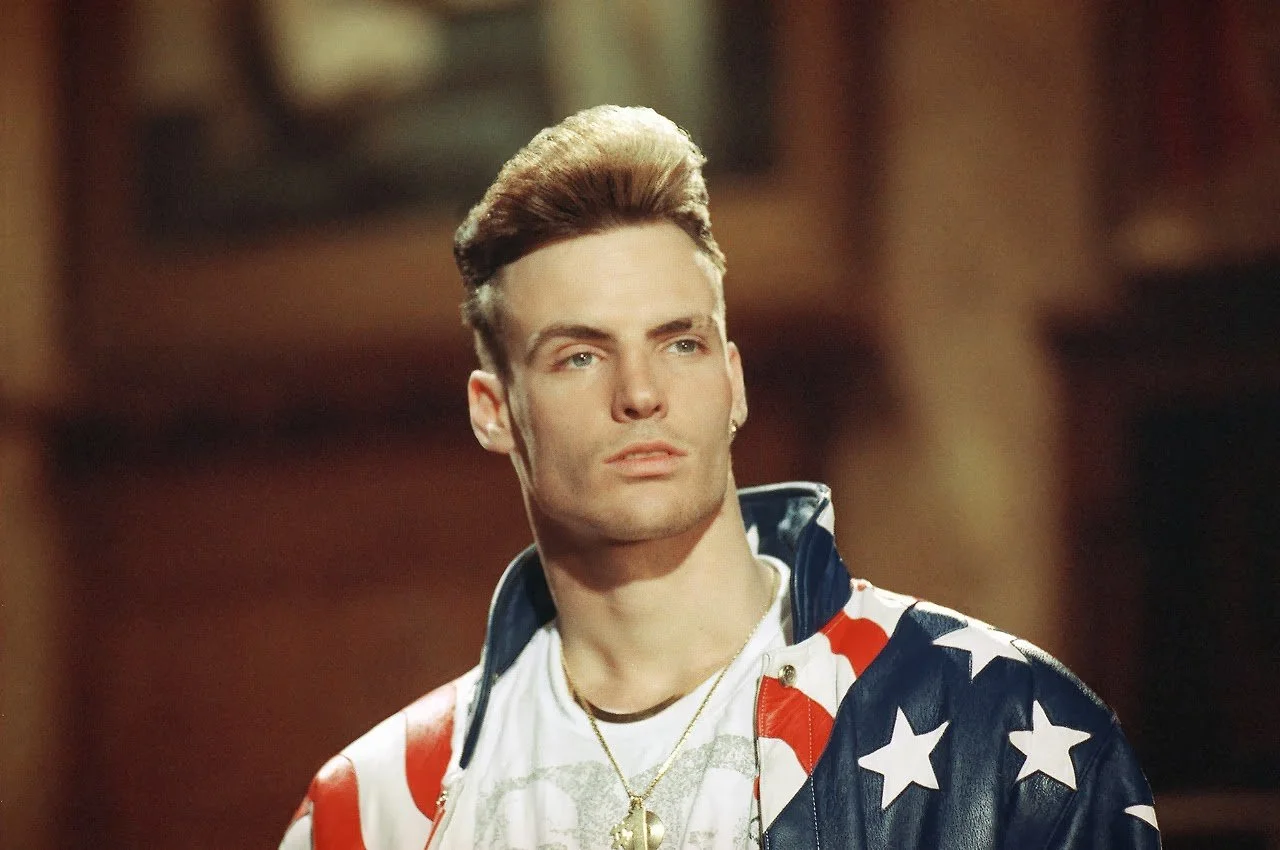
“Under Pressure” gave “Ice Ice Baby” its central musical hook: the repeating bass figure, rhythmic phrasing, sparse piano accents, and recognizable atmosphere that drive the later song. Vanilla Ice and his collaborators built a different record around that foundation, adding new rap lyrics, vocals, sections, narrative, and pop-rap identity. The connection is larger than one bass part—but it does not make the two songs identical.
The Foundation Came From “Under Pressure”
Queen and David Bowie recorded “Under Pressure” at Mountain Studios in Montreux, Switzerland, in 1981. Queen’s official history describes the collaboration as an unplanned studio session, and the single was released later that year.
The record reached No. 1 in the United Kingdom and remained there for two weeks. Queen subsequently included it as the closing track on the 1982 album Hot Space. The composition is formally credited to Bowie and all four members of Queen: Freddie Mercury, Brian May, John Deacon, and Roger Taylor.
Its opening is unusually efficient. A repeating bass figure establishes the song before the full vocal drama arrives. Piano accents and minimal percussion leave open space around it, making each element easy to hear—and difficult to forget.
That opening architecture is what listeners recognize when “Ice Ice Baby” begins.
The Bass Line Was Only the Beginning
The most obvious inheritance is the bass figure. Its shape and placement create an immediate connection between the two records. But contemporary reporting and later technical analysis identify more than an isolated bass part.
In a 1991 Los Angeles Times interview, Brian May identified the prominent “Under Pressure” bass line as a key element used by “Ice Ice Baby.” A 1998 Electronic Musician account described the borrowed foundation more broadly as the source song’s signature rhythm, bass line, and piano. An educational analysis archived by ERIC similarly identified a bass line, piano chord, and finger snap among the captured and looped elements.
A Rutgers Law Review analysis likewise found the instrumental passages nearly identical, with both using bass for the primary phrase and piano for a shorter secondary phrase. The analysis noted an added note in “Ice Ice Baby” but concluded that the borrowed passage remained the principal hook.
Together, those elements create a musical environment. The bass supplies the hook, while the surrounding rhythm and punctuation preserve the feel of the original opening. Even before the rapper establishes his subject or persona, the listener has been placed inside a familiar sonic frame.
That familiarity was valuable. “Under Pressure” did not merely contribute notes; it contributed recognition. The sound carried an existing identity and gave “Ice Ice Baby” a foundation audiences could identify within seconds.
What “Ice Ice Baby” Added
Borrowing a foundation is not the same as reproducing an entire song. “Ice Ice Baby” added its own rap lyrics, lead vocal, characters, setting, and performance style. Its verses present Vanilla Ice’s persona through scenes of nightlife, danger, confidence, and crowd control. That narrative does not come from “Under Pressure.”
The newer record also reshaped the material for a different purpose. Queen and Bowie’s song builds toward a dramatic vocal exchange about fear, compassion, and human strain. “Ice Ice Baby” turns the recurring hook into the engine of a rap single, using it beneath verses and title-centered refrains.
Its structure, vocal delivery, and commercial presentation belong to the pop-rap world of the turn of the 1990s. Technical and legal analyses agree that the lyrics and vocal melodies differ even though the instrumental foundation is closely related. The Queen and Bowie recording supplied the recognizable musical framework; Vanilla Ice and his collaborators supplied the newer song’s words, rap performance, storyline, and public identity.
The verified overlap is therefore musical rather than a reuse of Bowie’s or Mercury’s lyrics or recorded vocals.
The Song Existed Before Its 1990 Breakthrough
“Ice Ice Baby” was not created only after Vanilla Ice reached a major label. Vanilla Ice’s official discography and AllMusic place the song on Hooked, an album issued by Ichiban Records in 1989. The Atlanta History Center’s history of Ichiban Records confirms that the label released Hooked that year and that “Ice Ice Baby” appeared on it.
After the song began attracting attention, the material was repackaged for the SBK/EMI era and appeared on the 1990 album To the Extreme. Contemporary reporting described SBK acquiring the earlier album and contract before remixing and expanding the project for its major-label release.
The record then became a transatlantic hit. Contemporary Billboard records show that it reached No. 1 on the Hot 100 in November 1990. The Official Charts Company records four weeks at No. 1 in the United Kingdom, a run also documented by contemporary British chart reporting.
That success increased the value of the borrowed foundation—and the importance of determining who should receive credit for it.
Permission Had Not Been Secured First
Contemporary and industry accounts agree that the “Under Pressure” material had not been properly cleared before “Ice Ice Baby” was released.
Brian May told the Los Angeles Times in February 1991 that Vanilla Ice had not asked Queen before using the song and that Queen initially would not have received money from it. Contemporary reporting in Music Express said Hollywood Records demanded compensation for the unauthorized use of the bass lick. Electronic Musician later reported that the source had not been credited or cleared before legal threats produced an out-of-court settlement.
Billboard reported in November 1990 that Queen, Freddie Mercury, and the appropriate publishing affiliates were added to the writing credits while “Ice Ice Baby” was at No. 1. Later Billboard reporting described the bass line as an unlicensed sample and said the credits were adjusted during the song’s chart-topping week.
Most of the technical and industry sources reviewed describe the production as sampling parts of the “Under Pressure” recording. Some licensed-media metadata has instead described the use as an interpolation or more generally as containing elements of the earlier song.
The publicly available sources do not conclusively settle whether every audible component was lifted directly from the master recording, replayed, or assembled through a combination of methods. “Reuse of musical and recorded elements from ‘Under Pressure’” is therefore the safest comprehensive description.
Why the “Extra Note” Argument Did Not End the Debate
Vanilla Ice publicly defended the newer passage by demonstrating what he said was a small rhythmic difference between it and “Under Pressure.” The comparison became one of popular music’s best-known attempts to distinguish a borrowed hook from its source.
But the small variation did not erase the larger musical relationship. The recurring figure, its rhythmic function, the supporting piano, and its placement still direct the listener toward “Under Pressure.” May publicly identified the source, contemporary industry reports described it as unauthorized borrowing, and technical and legal analyses found the passages nearly identical despite the added note.
Copyright law does not provide a universal rule allowing a person to avoid clearance merely by changing one note. The U.S. Copyright Office says there is no fixed minimum amount of music that may always be used without permission and that sampling and interpolation questions must be evaluated case by case.
In this instance, the revised credits are more revealing than the televised defense. They formally recognize the writers of “Under Pressure” as writers of “Ice Ice Baby.”
What the Private Settlement Changed
The legal history is often summarized as Queen and Bowie winning a lawsuit, but the public accounts conflict on whether a formal court case was ever filed.
May told the Los Angeles Times in 1991 that Hollywood Records had sued Vanilla Ice’s record company and that a settlement was being developed. Later Billboard reporting and the George Washington University Music Copyright Infringement Resource say that no lawsuit was formally filed. The ERIC analysis says legal action was taken but that the dispute never reached trial.
What can be confirmed from multiple sources is a legal dispute followed by an out-of-court settlement. Electronic Musician and the ERIC analysis both describe the settlement amount as undisclosed. No reliable public source reviewed provides the royalty percentages or private division of the resulting income.
The lasting public result appears in the credits. Contemporary Billboard reporting documented the addition of the earlier work’s writers and publishers. Modern catalog and licensing records list David Bowie, Freddie Mercury, Brian May, John Deacon, and Roger Taylor alongside Robert Van Winkle, Floyd Brown, and Mario Johnson as writers of “Ice Ice Baby.” Those credits recognize the compositional role of “Under Pressure,” although they do not disclose the parties’ private financial shares.
So what did “Under Pressure” give to “Ice Ice Baby”? It gave the later record its central hook, rhythmic framework, musical atmosphere, and instant recognizability. “Ice Ice Baby” added a new voice, story, arrangement, and pop-rap character. The revised credits ensured that the writers behind the inherited foundation received formal recognition.







Leave a Reply