

Willie Mae “Big Mama” Thornton made the first known recording of “Hound Dog.” She recorded it in Los Angeles on August 13, 1952, nearly four years before Elvis Presley entered an RCA studio to cut his famous version. Thornton was not Presley’s only predecessor: at least eight other performers recorded the composition before his July 1956 session.
That fuller history turns “Hound Dog” into more than a story about an original and a cover. The song traveled through blues, R&B, country, western swing and early rock and roll before Presley transformed it into a major popular hit.
Big Mama Thornton Recorded the Original
Jerry Leiber and Mike Stoller wrote “Hound Dog” specifically for Thornton after bandleader Johnny Otis introduced them to her. Accounts from the Library of Congress, the Songwriters Hall of Fame and the songwriters themselves say the young writing team shaped the number around Thornton’s commanding personality and vocal presence.
The song was originally a blues rebuke aimed at an unreliable, exploitative man. Its central image was metaphorical—not an invitation to sing about an actual dog.
Thornton recorded “Hound Dog” with musicians from Otis’s orchestra. Peacock Records released the performance in February 1953 as Peacock 1612, credited to Willie Mae “Big Mama” Thornton with Kansas City Bill & Orchestra and backed with “Night Mare.” The Library of Congress, the Smithsonian and contemporary record documentation identify it as the original recording.
Thornton’s performance is loose, forceful and rhythmically assured. She does not simply deliver the composition; she controls its pace and attitude, turning the dismissal at its center into a declaration of authority.
The record spent 14 weeks on Billboard’s R&B chart, including seven weeks at number one, according to the Rock & Roll Hall of Fame and Smithsonian reporting. In 2016, it was selected for the National Recording Registry.
Who Wrote “Hound Dog”?
The legally recognized songwriters are Jerry Leiber and Mike Stoller. BMI, the Songwriters Hall of Fame and the federal decision in Valjo Music Publishing Corp. v. Elvis Presley Music support that attribution.
The original Peacock label also printed Johnny Otis’s name beside those of Leiber and Stoller. Otis maintained that he had contributed to the song’s development, but the federal court concluded that he had not written or collaborated in writing the composition. Thornton, meanwhile, testified that she supplied the melody she chose while the band provided its rhythmic backing, and she later described adding vocal interjections and other elements to her performance.
Those accounts are important to the song’s history, but they are different from its established legal authorship. Writing a composition, creating its first recorded interpretation and later popularizing it for a larger audience are separate achievements.
Every Confirmed Pre-Elvis Recording
Thornton’s hit quickly inspired recordings for several musical markets. Contemporary issues of Billboard and Cash Box, surviving record labels and established discographies document the following direct versions before Presley’s July 2, 1956 session:
| Performer | Date or release period | Label and catalog | Place in the story |
|---|---|---|---|
| Big Mama Thornton | Recorded August 13, 1952; released February 1953 | Peacock 1612 | First known recording |
| Billy Starr | Issued in 1953 | Imperial 8186 | Early country interpretation |
| Little Esther | Issued in 1953 | Federal 12126 | R&B cover |
| Betsy Gay | Issued in spring 1953 | Intro 6070 | Country-market cover |
| Jack Turner and His Granger County Gang | Issued in spring 1953 | RCA Victor 20-5267/47-5267 | Country adaptation |
| Eddie Hazelwood | Issued in spring 1953 | Intro 6069 | Country-market version |
| Tommy Duncan and the Miller Bros. | Issued in 1953 | Intro 6071 | Western-swing interpretation |
| Cleve Jackson and His Hound Dogs | Issued in 1953 | Herald 6000; matrix H-1015 | Another early cover |
| Freddie Bell and the Bellboys | Issued in 1955 | Teen 101 | Immediate model for Presley |
These recordings show how quickly a successful song could move between audiences in the early 1950s. Thornton’s performance remained the starting point, but artists and record companies recast the material for R&B, country and regional markets.
The sequence also corrects a common assumption: Presley’s recording was not simply the next major version after Thornton’s. By 1956, “Hound Dog” already had a substantial recording history.
How Freddie Bell Changed the Song
Freddie Bell and the Bellboys provided the crucial link between Thornton and Presley. Their 1955 release on Teen Records accelerated the tempo, changed portions of the lyric and converted the blues confrontation into a comic rock-and-roll routine.
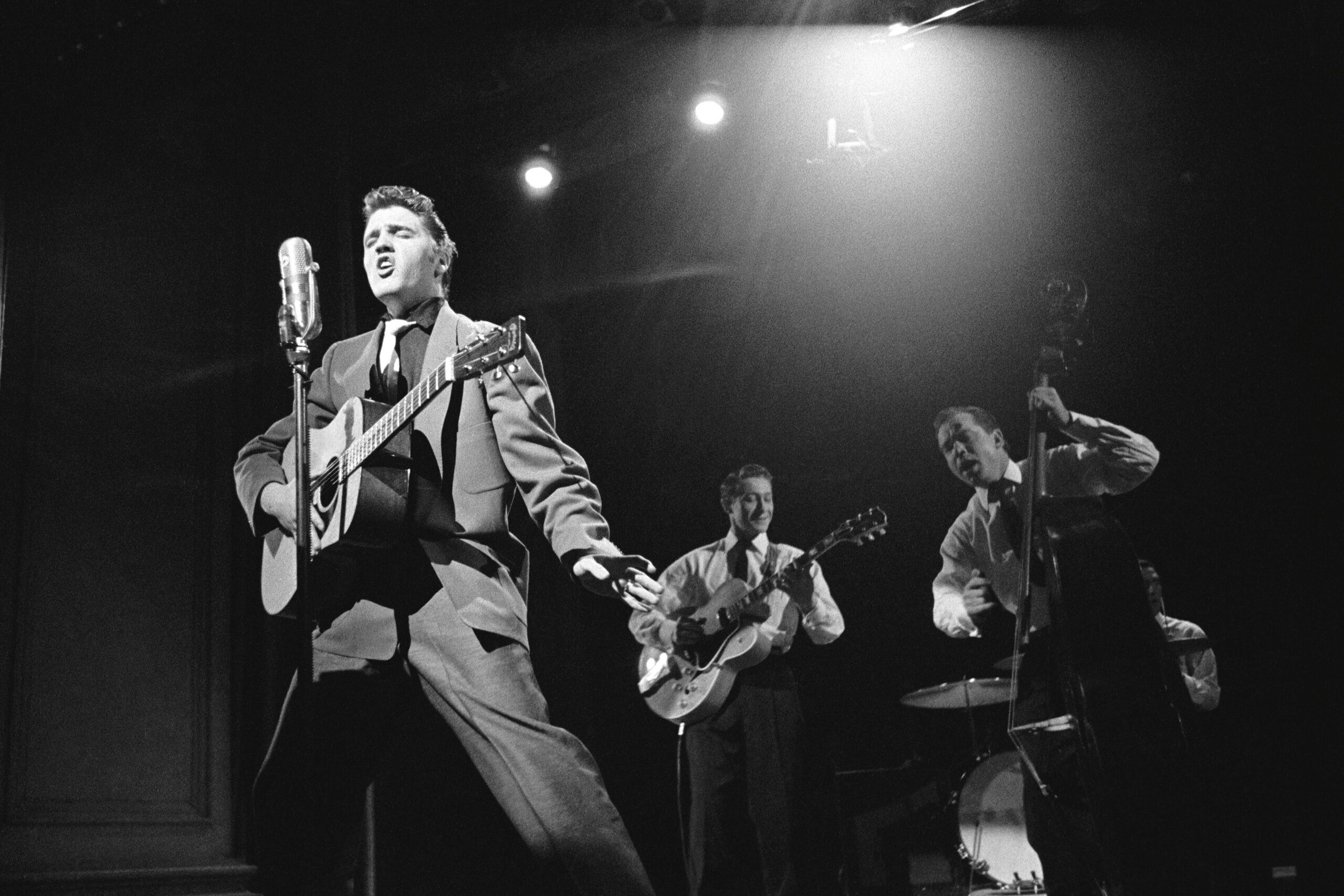
Presley saw the Bellboys perform “Hound Dog” during his 1956 engagement in Las Vegas and added their treatment to his own stage act. In an interview with Ken Sharp, Mike Stoller said Presley already knew Thornton’s recording but used the altered words and approach heard in Bell’s version.
That does not make the Presley record an imitation of Thornton’s arrangement. The two performances differ sharply in tone and musical purpose. Thornton’s recording is a tough adult blues performance directed at a disreputable man. The Bellboys turned the song into a brisk novelty number, and Presley adopted that revised lyrical and rhythmic framework.
Elvis Records His Version
Presley recorded “Hound Dog” at RCA Studios in New York on July 2, 1956. RCA Victor released it on July 13, paired with “Don’t Be Cruel,” according to Presley’s official discography and the University of Freiburg’s Songlexikon.
His performance intensified the Bellboys’ approach with a harder attack, a driving rhythm section and an extended series of takes before the master was selected. The resulting single carried “Hound Dog” far beyond the markets reached by its predecessors and made Presley’s rendition the version most listeners would recognize.
Its enormous visibility also compressed the song’s history. Thornton was often treated as a footnote to Presley even though her recording had been a major hit in its own right, while the intervening covers—and Bell’s decisive adaptation—largely disappeared from popular memory.
The Records That Were Related but Not Covers
Several additional pre-Presley recordings belong to the wider “Hound Dog” story without qualifying as straightforward performances of the Leiber–Stoller song.
Rufus Thomas Jr.’s 1953 “Bear Cat,” released as Sun 181, was an answer record that responded to Thornton from another perspective. Its original label called it “The Answer to ‘Hound Dog,’” and contemporary Cash Box coverage likewise presented it as an answer to her hit.
Cozy Cole and His All Stars issued the instrumental “Hound Dog Special” on MGM 11794 in 1954. That same year, Frank “Dual Trumpeter” Motley and His Motley Crew, with Curley Bridges singing, issued “New Hound Dog.” Contemporary Cash Box coverage described the latter as a new version of the earlier blues hit. Both were derivatives rather than straightforward covers.
Keeping these records separate prevents the timeline from becoming inflated while still acknowledging the creative wave Thornton’s success produced.
More Than a Before-and-After Story
The clearest answer remains simple: Big Mama Thornton recorded “Hound Dog” first.
The fuller answer recognizes a chain of contributions. Leiber and Stoller wrote the song. Thornton created its original recorded identity and carried it to the top of the R&B chart. Numerous performers adapted it before Presley. Freddie Bell and the Bellboys supplied the revised treatment Presley followed, and Presley gave that treatment unprecedented commercial reach.
Remembering the entire sequence does not diminish any one recording. It restores “Hound Dog” as a song with several distinct lives—and places Thornton where the recording history begins.






Leave a Reply