

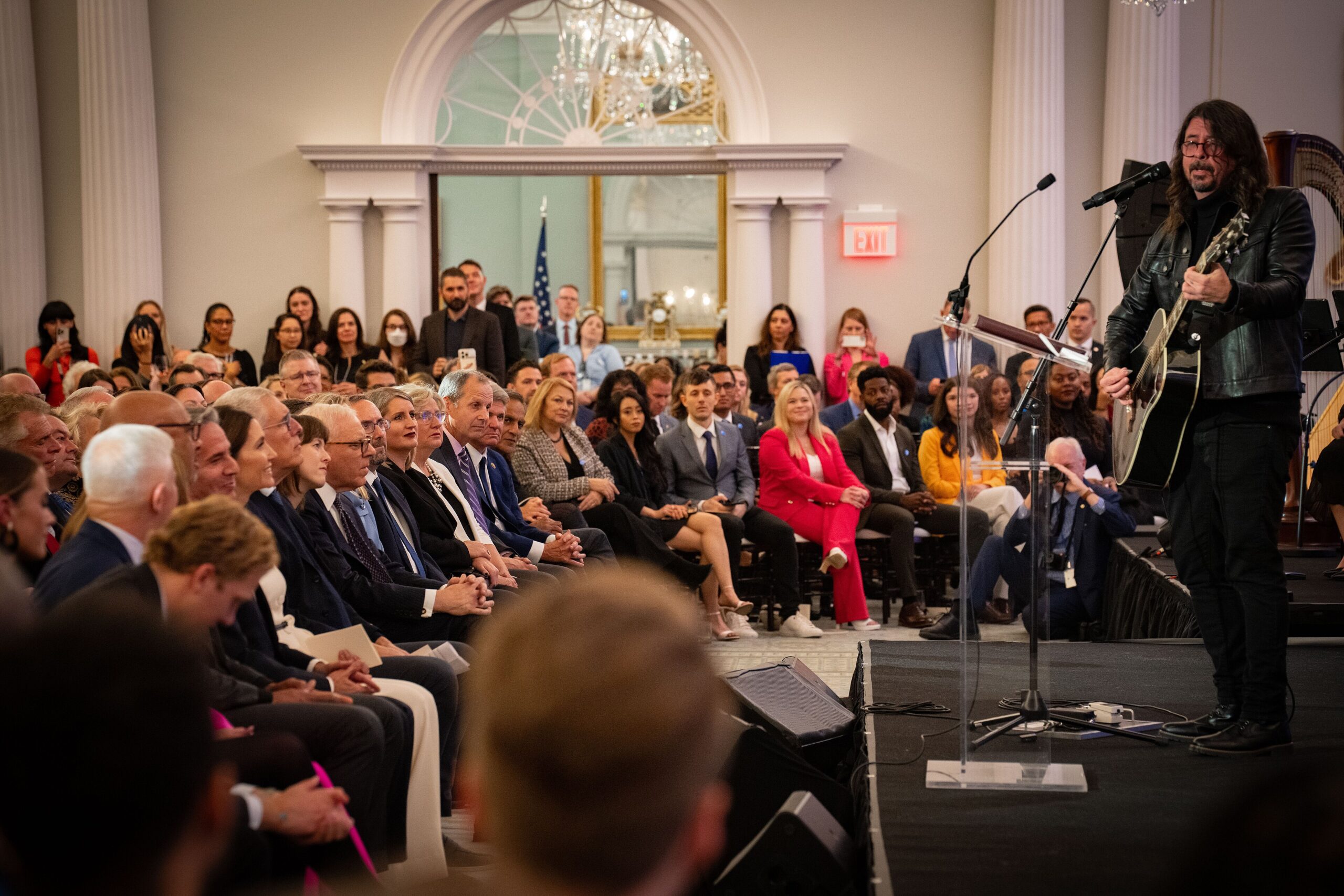
Dave Grohl cried after performing “Highway to Hell” with AC/DC because the moment completed a 46-year journey from awestruck fan to onstage collaborator. As he explained in an interview published by New Zealand radio station The Rock, seeing AC/DC’s concert film Let There Be Rock at age 11 helped shape his understanding of live performance. When he finally played beside the band at MetLife Stadium in 2026, the significance caught up with him after he left the stage.
What Happened at MetLife Stadium?
On October 2, 2026, Foo Fighters opened for AC/DC at MetLife Stadium in East Rutherford, New Jersey. The date and billing were confirmed by AC/DC’s official announcement and the stadium’s event listing. The concert had been rescheduled from September 25 because of dangerous weather conditions.
During AC/DC’s set, Grohl returned to the stage for “Highway to Hell.” NJArts and Louder reported that he played guitar and contributed backing vocals as the band performed one of its defining songs.
For the audience, it was a major rock collaboration. For Grohl, it carried a much longer personal history.
In his interview with The Rock, Grohl recalled walking offstage and breaking down in tears. Louder and Blabbermouth published matching accounts of his comments, describing the performance as one of the most full-circle moments of his life rather than a routine guest appearance.
Foo Fighters and AC/DC had shared a bill earlier that year, when Foo Fighters opened for the Australian band in St. Louis on September 8. AC/DC’s official MetLife announcement identified the New Jersey concert as their second shared bill, while Rolling Stone Australia and Blabbermouth confirmed the St. Louis date. But joining AC/DC for a song was different from simply appearing on the same lineup.
Grohl was stepping into the musical world that had helped teach him what a rock show could be.
The Story Began With an 11-Year-Old Fan
To understand Grohl’s reaction, the story has to return to 1980.
That year, an 11-year-old Grohl saw Let There Be Rock, AC/DC’s concert film, at a midnight screening. He has repeatedly identified the experience as formative. During the interview published by The Rock, he connected the film directly to his ideas about performing. Blabbermouth also documented an earlier statement in which he described how the film changed his approach to music.
Rolling Stone Australia reported that Grohl told the MetLife audience about that childhood experience during Foo Fighters’ opening set. His comments placed the collaboration inside a personal timeline: He had first encountered the band as a child watching from a theater seat, and now he was standing beside them in a stadium.
What captured him was not merely the band’s catalog. It was the physical force of AC/DC’s performances—the sense that every song demanded complete commitment.
That distinction helps explain why the memory survived decades of Grohl’s own success. He was not simply remembering music he liked as a child. He was revisiting an early model of what he believed a live rock band should be.
How AC/DC Influenced Grohl’s Approach to the Stage
Grohl’s career has included stadium concerts, major festival appearances and collaborations with generations of prominent musicians. Yet his comments about AC/DC reveal how deeply a childhood influence can remain embedded in an artist’s work.
In Grohl’s telling, Let There Be Rock demonstrated the power of total physical engagement with music. AC/DC did not present rock as a polished recital. The band treated a concert as an intense exchange with the crowd, driven by movement, volume and visible effort.
The connection to Grohl’s own performance style is difficult to miss, although it is best understood as an influence rather than a claim that one film created his entire musical identity. Across his career, he has favored direct communication with audiences, vigorous performances and an approach designed to make even enormous venues feel immediate.
Those qualities belong to Grohl, but AC/DC helped provide an early example. By his own account, watching the band showed him a standard of commitment that stayed with him as he became a performer.
That is why the MetLife appearance carried more weight than a celebrity cameo. Grohl was playing alongside musicians whose example had become part of his creative foundation.
Why “Highway to Hell” Carried Special Weight
The chosen song made the moment even more resonant.
APRA AMCOS and Columbia’s label-supplied recording metadata credit “Highway to Hell” to Angus Young, Malcolm Young and Bon Scott. AC/DC’s official history states that the band recorded it at Roundhouse Studios in London in April 1979, a location and period also documented by MusicBrainz. Columbia’s metadata and MusicBrainz identify Robert John “Mutt” Lange as the producer.
Apple Music’s label-supplied album page and Columbia’s recording metadata give July 27, 1979, as the release date. By the time Grohl encountered AC/DC through Let There Be Rock the following year, “Highway to Hell” belonged to the period that first captured his imagination.
He therefore was not joining the band for an incidental selection from its catalog. He was performing a signature song from the era associated with his earliest discovery of AC/DC.
The distance between those two experiences was enormous: from watching the band on a movie screen as a child to playing the same music with its members in front of a stadium crowd.
From Observer to Collaborator
Grohl’s tears make sense when the MetLife performance is viewed as three moments happening at once.
There was the 11-year-old fan discovering AC/DC in 1980. There was the developing musician who carried the band’s live intensity into his own understanding of performance. And there was the established artist standing onstage with the musicians who had once seemed larger than life.
For a few minutes during “Highway to Hell,” those versions of Grohl converged.
The emotional reaction came afterward because the appearance transformed a foundational memory into a lived experience. The people he had once studied from a theater seat were no longer distant figures on a screen. They were fellow performers sharing a song with him.
That change—from observer to participant—is the heart of the story.
Why the Moment Mattered
Artists’ careers are often measured through sales, awards, tours and headline appearances. But personal milestones do not always follow those public markers. Sometimes the most meaningful achievement is reaching the source of an old inspiration and discovering that the fan who first encountered it is still present.
Grohl’s tears showed that decades of success had not erased the emotional force of discovering AC/DC at age 11. If anything, his career made the MetLife moment more meaningful because he understood how far he had traveled to reach it.
He cried not simply because he had performed with a famous band, but because the performance collapsed 46 years into one song. The child watching Let There Be Rock, the musician shaped by its energy and the veteran performer beside AC/DC had finally arrived on the same stage.





Leave a Reply