

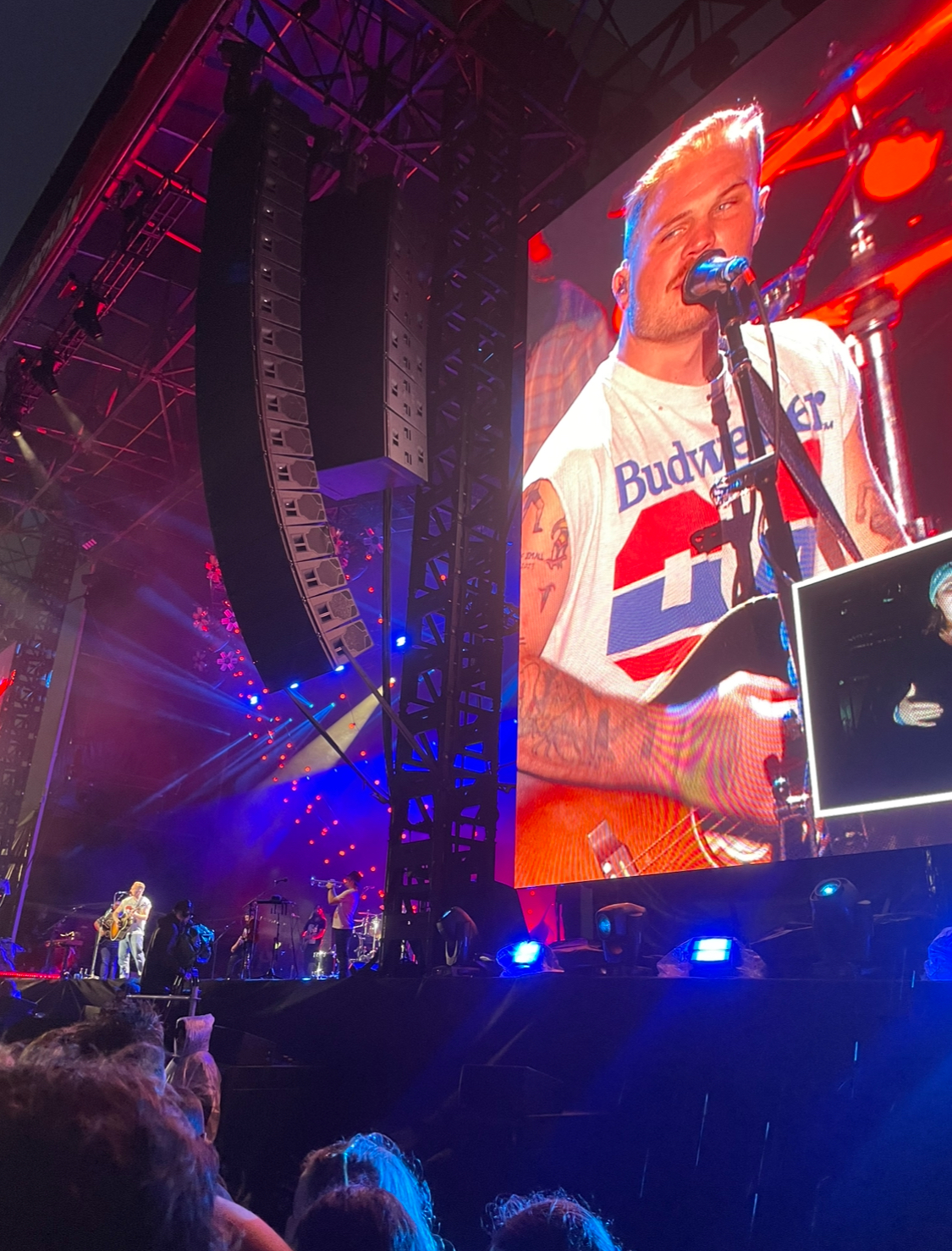
Zach Bryan is playing stadiums in 2027 because his audience has already proved it can fill them. His Young Manhood and Other Donatable Organs Tour will place 23 concerts in 19 stadiums across North America and Australia, turning what could have been treated as a pair of extraordinary attendance records into a repeatable international touring model. After drawing a reported crowd of 112,408 at Michigan Stadium, setting a Gillette Stadium attendance record with 73,538 and reaching No. 1 on the Billboard 200, Bryan is no longer testing stadium demand. He is building around it.
Two Record Crowds Changed the Calculation
Bryan’s clearest case for stadium touring comes from two concerts held roughly a year apart.
On September 27, 2025, he became the first artist to headline a concert at Michigan Stadium. AEG Presents and Pollstar reported an attendance of 112,408, establishing a U.S. record for a ticketed concert.
The size of that audience was remarkable, but one historic show does not necessarily establish a touring pattern. Michigan Stadium was hosting its first headlining concert, and the occasion carried significance beyond an ordinary stop on an established route.
Gillette Stadium provided a second—and importantly, different—measure of Bryan’s drawing power. His October 3, 2026, performance attracted a reported 73,538 people, according to AEG Presents, Pollstar and CBS Boston. It was the second of two Gillette dates on the With Heaven On Tour and produced the largest reported crowd for any event in the stadium’s history.
That distinction matters. Michigan showed the upper limit of Bryan’s appeal at a singular event. Gillette showed that he could produce another record crowd in a separate market, during a two-night engagement, at a venue accustomed to major sports and entertainment events.
Attendance figures alone do not reveal a concert’s profitability, ticket inventory or production costs. They do, however, provide unusually visible evidence that demand for Bryan extends well beyond arena capacity.
His Recorded Music Is Operating at the Same Scale
Bryan’s live growth has been accompanied by success at the top of the album market. Billboard’s published chart and UPI reported that With Heaven on Top reached No. 1 on the Billboard 200 chart dated January 24, 2026.
A chart-topping album does not automatically cause stadium ticket sales, and the available reporting does not establish a direct relationship between the two. Together, though, the chart result and attendance records describe an artist reaching a national audience through both recorded music and live performance.
That combination helps explain why the 2027 tour looks so confident. Bryan is not relying on a single viral moment, one unusually successful city or nostalgia for an established catalog. His latest full-length album reached the top of the primary U.S. album chart, while his concerts were setting records at two of the country’s largest venues.
His rise has been closely associated with the directness of singer-songwriter music: plainspoken writing, rough edges and songs that can feel personal even when thousands of people are singing along. The stadium tour tests whether that sense of intimacy can remain central when the physical setting becomes enormous. The crowds at Michigan and Gillette suggest that, for many listeners, scale has not weakened the connection.
The Routing Makes Stadiums the Strategy
AEG Presents announced the tour on October 14, 2026. The itinerary begins April 28, 2027, in Minneapolis and ends December 18 in Brisbane.
The first North American run covers 11 shows through June 2. A second six-show block begins in Las Vegas on July 16 and concludes in Boise on August 6. Bryan will then play six Australian concerts in December, with two dates apiece in Melbourne, Sydney and Brisbane.
The geographic spread is more revealing than the total number of performances. A stadium appearance in one major market can be designed as a special event. A tour distributed across 19 stadiums requires confidence that demand will travel.
The Australian schedule strengthens that message. Rather than adding one overseas showcase, the tour commits to multiple nights in three cities. It extends Bryan’s stadium model beyond North America while concentrating the Australian run in a small number of major markets.
The announced schedule separates the tour into three distinct blocks, giving the itinerary a clear seasonal rhythm. What is unmistakable from the route is that stadiums are not occasional flourishes around a smaller-venue tour. They are the tour.
The Supporting Lineups Make Each Stop a Larger Event
The opening acts reinforce the event-sized presentation without changing the central reason Bryan can headline these venues.
John Fogerty and Fey Fili are scheduled for the first North American block. Ryan Bingham and The Texas Gentlemen, along with Gabriella Rose, will support the summer dates. Vance Joy and Emma Ogier are listed for Australia.
The lineup spreads support among multiple billed artists rather than relying on a single opener throughout the tour. It would be speculative to assign a demographic strategy to those bookings, but the variety of performers adds depth to each stadium bill.
That matters when a concert is being positioned as a full-scale destination event. The lineup helps fill the day with distinct performers while leaving Bryan’s catalog and drawing power at the center.
A New EP Gives the Tour Its Story
The tour takes its name from Young Manhood and Other Donatable Organs, an eight-song EP scheduled for release through Warner Records on October 16, 2026.
MusicRow and JamBase identify Lana Del Rey as a featured artist on “Lies” and Turnpike Troubadours on “Plainsman.” Those collaborations broaden the project’s musical context while maintaining a connection to the Oklahoma scene Bryan and Turnpike Troubadours share.
An eight-song EP is not, by itself, expected to supply an entire stadium performance. Bryan’s broader catalog and the eventual set lists will shape the concerts. The new release instead provides the tour with a title, a creative frame and fresh material at the beginning of its promotional cycle.
It also keeps the 2027 itinerary from feeling like a victory lap for past achievements. The stadium dates are attached to a current release rather than presented solely as celebrations of the Michigan, Gillette or Billboard milestones.
Stadium Status Still Has to Be Reearned
The evidence supporting Bryan’s move is strong, but a stadium tour remains a substantial test.
Complete North American face-value pricing and venue-by-venue ticket inventory were not included in the cited tour announcements. Production design, running times and final set lists also had not been announced. Most importantly, record crowds at two concerts do not guarantee identical demand across every market.
A 19-stadium route requires Bryan to sustain interest across different regions, dates and local conditions. That challenge is precisely why the announcement is significant. The tour takes isolated proof points and turns them into a season-long commitment.
Michigan Stadium demonstrated how large Bryan’s audience could become. Gillette Stadium showed that the result could be repeated elsewhere. With Heaven on Top added evidence of national reach beyond the concert field.
The 2027 tour puts those achievements into one operating plan. Bryan is playing stadiums because, at this stage of his career, they are no longer merely the sites of his biggest nights. They have become the scale against which his next era will be measured.





Leave a Reply